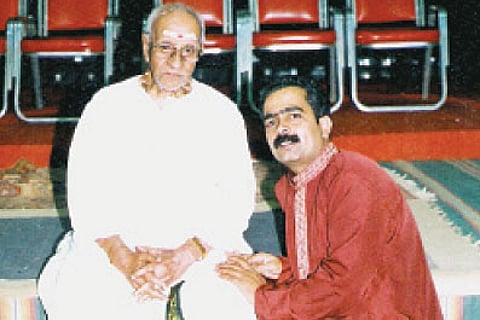

BANGALORE: With no frets (the raised element on the neck of a string violin), the violin is hard to master. The rarer seven-stringed variant of the violin is even a greater challenge to play. Popularised by T Chowdaiah, the tradition was taken forward by R R Keshavamurthy (1914-2006), whose birth centenary is being celebrated this weekend at Gayana Samaja.
“Madras Balakrishna Iyer started it off, but he wasn’t able to take it forward. Then, T Chowdaiah took it up. My father was a great fan of Chowdaiah. The violinist was a senior and fellow disciple of his guru Bidaram Krishnappa,” says Keshavamurthy’s son Sheshadri R K Murthy.
When it came to accompanying the greats in the music field during their time, it would have to be one of the two, adds G Venkatesh, a senior disciple of RRK, who learnt from him under the gurukula system for 20 years. Anyone who has come in contact with him during his lifetime says he was not a man to mince his words for the sake of civility, that he would let nothing come in the way of his music or his discipline. “He wouldn’t miss his morning music practice and his physical exercise for anything. And he’d give his health utmost importance,” says Venkatesh.
“He wouldn’t tolerate mediocrity in music; he’d immediately tell you that you’re insulting the art. Nor would he eat an extra morsel of food, drink an extra cup of coffee or delay meals because of guests or any other formalities,” says Sheshadri R K Murthy who has now given up his pharmaceutical career to pass on his father’s musical heritage to the next generation of students.
Sheshadri also remembers that another musician who had lived on the same street would set his watch every morning when RRK cycled down the road. Both Venkatesh and Sheshadri were taught how to play the seven-stringed violin by RRK. “When you play it well, it sounds like a duet sung by a male and a female voice. But if it’s not perfectly tuned, it will drive people out of the concert hall,” they said.
After Keshavamurthy was confined to his bed in 2005, he stopped recognising family and relatives.
“But talk to him about music, and he’d seem his old self,” Sheshadri recalls. Around that time, Venkatesh had a performance and came to take his guru’s blessings prior to it. “The family told me that it was unlikely that he’d recognise me. But as soon as I touched his feet, he called me by name and showered me with blessings,” he says, reliving the moment.
Keshavamurthy has also authored several books, some of which Venkatesh is grateful to have now. Long before the electronic instrument era, the musician also had small tamburis made, which were easy to travel with, the disciple shares.
Though known best as a violin artiste, Keshavamurthy also trained several students in Karnatak music. Meenakshi Ravi, now a teacher herself, is exploring the therapeutic aspects of music on the differently-abled. She learnt from him for 10 years – from when she was a class nine student till a few months after she got married.
“My grandfather, veena artiste Emani Shankara Shastri, was a great friend of RRK’s. That’s how I started learning from him. My lesson would be for 15 or at the most 20 minutes, but I’d be at his house from 2.30 in the afternoon till about 7, tuning his tamburis and dusting his violins,” she reminisces.
She would go to Mandya for summer vacations. “I’d tell my guru that I’d be gone for a month, but I’d miss my music classes so much that I’d hasten back in a week,” she says.
(Spread over June 14 and 15, Gurusmruthi, will see a violin-sitar Jugalbandi by Mysore M Nagaraj and Ustad Rafiq Khan on Saturday evening and a 25-veena concert directed by Suma Sudhindra, Shiva kritis by T S Sathyavathi, Devi kritis by Nagamani Srinath and a percussion ensemble by T A S Mani the following morning).
