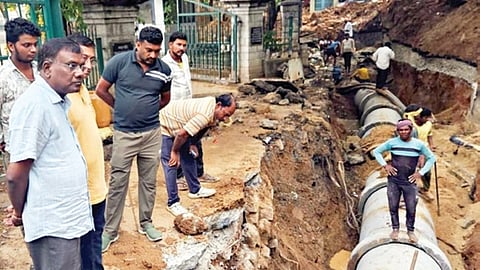

BENGALURU: After Infosys techie Bhanu Rekha’s death at the flooded KR Circle underpass following heavy rains on May 21 2023, the Bengaluru Central City Corporation has stopped the stormwater gushing into the underpass now. The engineers said they had to install a 61-meter precast 900mm diameter RCC diversion channel, precast underpass chambers, gratings and a compound wall and barricading worth Rs 77 lakh to arrest water flow and fix the water stagnation once and for all.
Similarly, at the Golf Course underpass, at the entry and exit ramps, asbestos sheets have been installed to arrest the flooding of rainwater. “With a 900 Dia Pipe under KR Circle underpass and other civil works in the junction, the Bengaluru Central City Corporation (BCCC) has managed to fix the water stagnation issue once and for all.
Similarly, the entry and exit ramps of the Golf Course have been installed with asbestos roof sheets, and a drain has been constructed to arrest the water stagnation,” said Venkatachalapathi R, the Additional Commissioner, Development, BCCC, adding that traffic near KR Circle and the Golf Course will not be impacted during rains as there will not be any water stagnation.
Earlier, the existing storm water lead-off pipeline at KR Circle Underpass was found to be completely choked due to heavy accumulation of silt, debris and sediment resulting from the lack of periodic desilting and routine maintenance over several years.
Consequently, the pipeline had lost its hydraulic capacity, leading to frequent water stagnation and flooding of the underpass during rainfall events.
The engineers said a Ground Penetrating Radar (GPR) survey was carried out to identify and trace the alignment of the existing underground stormwater pipeline.
However, the survey could not establish the complete alignment due to the presence of multiple underground utilities, including water supply lines, electrical cables, communication cables, and other service lines running above and along the same alignment.
In addition, the pedestrian subway crossing intersecting the existing drain further restricted the investigation and made accurate tracing of the pipeline alignment impractical. “As the existing pipeline was filled with compacted silt throughout its entire length, conventional cleaning or desilting methods were not feasible.
The severe blockage rendered the existing drainage line non-functional, and restoration through cleaning alone was not considered technically viable,” said the engineer.
The new pipeline was connected to the nearby stormwater drain inside the Public Works Department (PWD) with appropriate hydraulic gradients to ensure efficient gravity flow. Inspection manholes were provided at suitable intervals along the pipeline to facilitate future inspection, cleaning, and maintenance.
“The diversion pipeline is fully operational and passes stormwater from the underpass to the existing stormwater drain,” said the additional commissioner.
