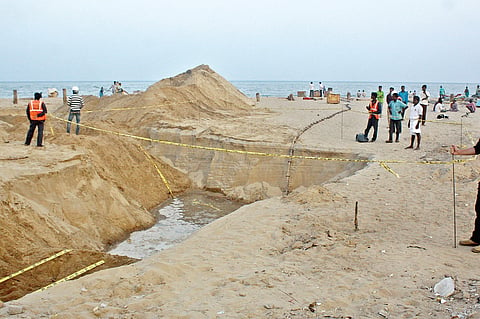

CHENNAI: The 100 Gigabits per second Bay of Bengal Gateway submarine cable project has made landfall in Chennai - scuba-diving gear fitted workers from Reliance Jio Infocomm Ltd, the project’s India partner, are currently working at Santhome Beach laying the Chennai end of the 8,040 km cable. The project, which has reached Chennai’s shores in the vicinity of Nochikuppam, is considered a vital part of India’s future hi-speed internet infrastructure.
While Reliance Jio Infocomm was not available for comment on the status of the project, sources at the site told the Express that the submarine part of the cable link had been completed. The work currently ongoing at Santhome is the landward portion of the cable, and work on the same is expected to be completed very soon. “While we cannot comment on when the cable link will become operational, the submarine portion of the cable has been completed and we are working on the portion that make landfall,” said the source.
The environment clearance for the BBG Submarine cable system in Chennai was given by the Ministry of Environment, Forests and Climate Change in a document dated February 3, 2015.
According to the clearance, the cable would connect countries in the Middle East - Oman and United Arab Emirates with India, Sri Lanka and Malaysia.
Two branches of the ultra high speed communications system would connect with India at Chennai on the East Coast and Mumbai on the West Coast.
The Mumbai landing of the BBG Submarine Cable System will be constructed by Vodafone South and environment clearance for the same was granted by the MoEF&CC recently.
The BBG cable system is one of several currently underway to connect India with the Indian Ocean region and the rest of the world with ultra high speed communications.
The BBG System alone has a total cable length of 8,040 km. From its terminating points in Barka, Oman to Penang, Malaysia, the cable measures a whopping 5,934 km in length.
Four other branches split off from the main line - a 216 km branch to Fujairah, in the UAE, a 426 km branch to Mumbai, a 142 km branch to Colombo, Sri Lanka, and a 1322 km branch to Chennai, bringing the total length of high-speed cable to 8,040 km.
The 100G Submarine Communications Cable has been built by the Alcatel-Lucent Submarine Networks and leading telecom companies from the countries connected by the system formed a consortium in 2013. Other than India’s Reliance Jio Infocomm, others in the consortium is the UK-based Vodafone Group, Malaysia’s Telekom Malaysia Bhd, Oman’s Omantel, UAE’s Etisalat and Sri Lanka-based
Dialog Axiata. Reliance Jio also received environmental clearance from the MoEF&CC for another of its submarine cable systems, the AAE-1, in early January this year.
