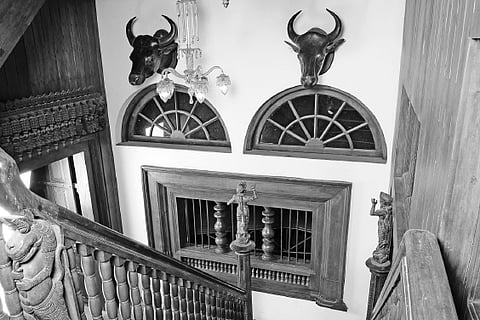

At the Kerala Folklore Theatre and Museum, at Mattanchery, one does not just see art, but feels it. The building pulsates with the memories of its numerous artefacts - not some rich royal memorabilia, but simple elements from the daily lives of people who live ordinary, uneventful lives. From string puppets to leaf scrolls, from ornate doors to burial pots, the unsung lore of the commoner unfolds here.
What is more impressive is that this is a personal collection. The museum, situated at Thevara, is the result of the deep passion of two people, George Thaliyath and Annie George Thaliyath. “I love art and architecture,” says George. “Most of the museums in our country focus only on the established and the well-known, like royal artefacts or remnants of colonialism,” he says. “But there is another part of history that is often overlooked: the commoner.”
The museum took seven years to construct, and George and Annie designed it themselves. “We were lucky to have excellent masons and carpenters, who were very understanding,” says Annie. “No trees were cut. The woodwork is restored from old houses.”
The building style is a combination of three different schools of traditional Kerala architecture: the Malabar, Kochi and Travancore styles. These are represented on the ground floor, first floor and second floor respectively. “A must-see feature is the wood carved ceiling of the second floor that weighs 60 tonnes,” says Rinsy Nawab, the museum in-charge. “Many of the paintings on display contain actual gold and gems.”
The museum also organises classical and folk art performances by professionals and amateurs, on request. “Earlier we had daily performances, but since the turnout was low, we discontinued it,” says George. “Unfortunately, foreigners are more interested in our culture than we are. This is because we do not have a practice of art and historical education.”
He says that there is a need to go beyond textbooks and educate the young generation about the lesser-known aspects of history. “We have a rich cultural history, especially in the folk and tribal cultures,” he says. “How many people know about them? There is a need to enlighten the youngsters about our culture, and that was my objective in starting the museum.”
George, who used to be an art dealer, quit the business a few years ago. “Many elements of our history are now outside India and lost to us,” he says. “I didn’t want to be part of it, even indirectly.”
Meanwhile, their path is not without hurdles. There are as many critics as there are admirers, perhaps even more. “It is discouraging when people do not even acknowledge your effort,” says Annie. Most tour operators are indifferent towards the museum. Perhaps, it is because they are not interested in procuring business by paying a commission. “This is not a business, but a passion,” says George. “That is why we have never done any promotions or taken out advertisements.”
Annie says that it is especially disappointing when people, who are expected to be wise, act negligent. “Even teachers and school principals are hardly convinced,” she says. “They are the ones who should encourage children to learn about their heritage.”
However, amidst the indifference and criticism, there are some who acknowledge the value of this initiative. “Once an elderly lady who visited the museum hugged me and said that she was transported to another era,” says Annie. “Such incidents encourage us a lot.”
