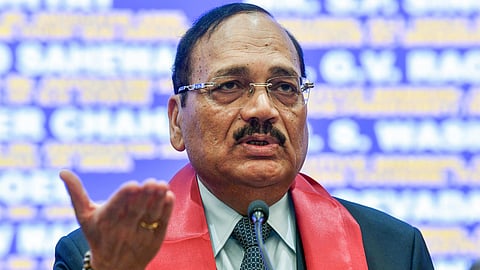

Chief Justice of India (CJI) Surya Kant on Monday declined a request by Opposition leaders Rahul Gandhi and Mallikarjun Kharge for a meeting, saying that discussing matters pending before the Supreme Court would be incompatible with judicial propriety and the constitutional principle of separation of powers.
In a letter to the Congress leaders, the CJI said the issues raised by them were already sub judice and urged them to approach the court through a formal petition rather than submit a memorandum through the administrative route.
The development comes as INDIA bloc leaders prepare to march to the Supreme Court on Monday to file a petition against Chief Election Commissioner Gyanesh Kumar over alleged electoral irregularities and “vote chori”.
“I received a letter yesterday regarding a meeting request, and I responded to it last night, outlining the reasons why I will be unable to meet,” Justice Surya Kant told reporters after the National Human Rights Commission’s 33rd Foundation Day function.
In his letter to Gandhi, the Leader of the Opposition in the Lok Sabha, and Kharge, the Congress president, the CJI said convening a meeting to discuss pending cases would be improper under the constitutional framework.
“At the very outset, it may be noted that the issues referred to hereinabove are already sub judice before the Supreme Court of India,” he wrote.
“Therefore, convening a meeting to discuss pending cases would wholly contravene the principle of Separation of Powers, an intrinsic facet of the basic structure doctrine of the Constitution of India, and would be incompatible with the established ethics and judicial propriety,” the letter stated.
The CJI also clarified that the Supreme Court did not have administrative powers to address the concerns raised in the Opposition leaders’ letter, but was duty-bound to consider matters affecting citizens’ rights through judicial proceedings.
“In this vein, I also wish to remind you that within our constitutional framework, the Supreme Court of India is not endowed with any administrative powers to deal with the issues highlighted in your letter,” he said.
“However, in the exercise of our jurisdiction under Article 32 of our Constitution, along with other plenary powers, including that of judicial review, we are duty-bound to consider on judicial side the gravamen of issues affecting the citizens of India,” Justice Surya Kant added.
The CJI reiterated that citizens could approach the Supreme Court to seek enforcement of their fundamental rights and that such matters would be considered in accordance with the law.
“The Supreme Court of India reiterates its commitment to preserve and protect the Fundamental Rights of every citizen of India and that they are entitled to seek enforcement of such rights at all hours through the procedure known in law,” he said.
“It would thus be more appropriate on your part to invoke the judicial powers of the Supreme Court of India, instead of submitting a memorandum on the administrative side,” the letter added.
Gandhi and Kharge had written to the CJI on October 10, seeking a meeting between 4 pm and 5 pm on October 12 to submit a memorandum concerning the Chief Election Commissioner and the Election Commission of India. Their letter also raised concerns over the alleged arbitrary arrest of several students, the closure of Metro stations and the cancellation of trains, among other issues.
Earlier on Monday, Justice Surya Kant had told reporters that every Indian citizen had the right to approach the courts and that the Supreme Court’s doors remained open to all.
“The Supreme Court’s doors are open to everyone. Any petition from any common citizen or member of an elected body is welcome. Every Indian citizen has the right to approach the court, and we will hear their concerns and grant whatever is due under the law,” he said.
The INDIA bloc has been demanding accountability from the Election Commission over alleged irregularities in the electoral process and has sought the resignation of Gyanesh Kumar.
Meanwhile, security was tightened across central Delhi ahead of the Opposition’s planned march. Barricades were erected at several locations, while entry and exit at certain Metro stations were scheduled to remain closed until 4 pm on October 12 for security reasons.
Security personnel were deployed along Barakhamba Road and near Mandi House, with the Rapid Action Force (RAF), the Central Reserve Police Force (CRPF) and Delhi Police personnel involved in the arrangements.
(With inputs from PTI)
