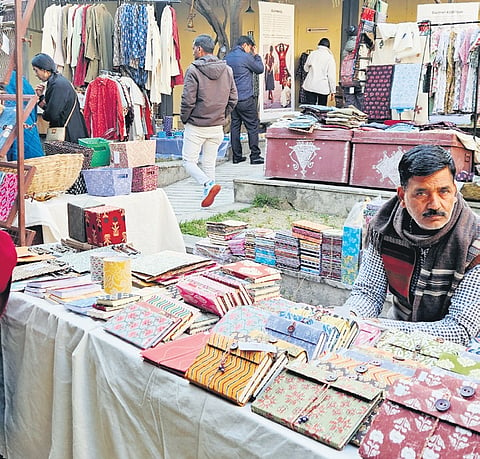

The amphitheatre of Triveni Kala Sangam is buzzing with visitors and live Rajasthani folk music. Each step, adorned with multi-hued home linens, textiles, jewellery, home décor, leather work and furniture, exhibits exquisite local craftsmanship from the state of Rajasthan. The first Tilonia Bazaar was exhibited in Triveni Kala Sangam in Delhi in 1975 encouraged by cultural activists Kamaladevi Chattopadhyaya, Pupul Jayakar, Shona Ray and others, and it has been bridging the gap between rural craft and urban India since then. This year’s edition features a new collection of comfort apparel called ‘Araam’, among several other fresh products.
The bazaar, which is on till February 12 and boasts fine work by the rural artisans of the desert land, is an offshoot of the Barefoot College. Founded by Sanjit ‘Bunker’ Roy in 1972, the college is a non-profit based out of Tilonia in Rajasthan that has been involved in uplifting underprivileged communities from rural backgrounds across India. In 1975, when villages in Rajasthan were grappling with unemployment, leading to mass migration to cities, most artisans were unable to continue with their work and the local market was dwindling. It was in the same year that Barefoot College began promoting rural handicrafts through Tilonia, an initiative that brings local artisans together to make and sell their works, with a special focus on minorities.
Shweta, a member of the governing body of Tilonia, believes that the bazaar helps thousands of artisans from villages to find alternative markets in India. “Women from the villages in Rajasthan are trained so they can work from their homes. They use their traditional skills and we help them find the market sell their products.”
Among other crafts on display, apparels such as kurtas, skirts and jewellery stand out with their intricate designs. Block prints, embroidery, kantha and Barmer prints adorn even bed covers and linens. “These block print fabrics is from various block print clusters near Ajmer, like Bagru and Sanganer. There are also some Balotra and Ajara prints that come from Barmer. Most of these handloom kurtas and pants come from Tilonia,” Shweta adds.
Spread across the area, one can see the intricate patchwork and handwoven work on the bed covers and rugs. One of the artisans, Kailash Kanwar, who has been working with textiles for the last 36 years says that the detailing of each work takes a very long time to make. “For these Barmer prints, two women work for one bed cover and it takes them at least a month or more to finish one piece. I have learnt sewing and block printing from here back when I started as an artisan. Now more than 800 artisans work under me and we all make these products together,” she says.
Kanwar, as she explains the detailed work on a kurti, reflects upon how things have changed for the better. “Each product here has the name of the artisan who made them,” she says as she presents a small tag with the name ‘Jyotika’ attached to the apparel. “It takes a lot of work for us to make these products and we are glad we are able to show it. Rajput women were not allowed to even step out of the house, let alone work. Now, we have been able to work independently, even from the confines of our houses,” she adds.
The bazaar was also lined up with wood work, handmade diaries and toys. “Some of these designs are very specific to the area,” explains Shweta. “One does not find it commonly unless the designs are made by the local artisans themselves.”
Another artisan, Nandu, who has been part of the exhibition from the past 36 years, is a master in several styles of weaving and stitching. “We ensure that women from all age groups partake in the process, and focus on widows and people with disabilities. I have thousands of these women from different villages working under me,” she says.
Over the years, several thousands of artisans from the rural regions of the country have been employed and been able to revive their traditional crafts due to the initiative. Tilonia Bazaar offers one a glimpse into the state’s rich cultural heritage and craftsmanship and a chance to partake in it.
