
Haveri: Father of the nation Mahatma Gandhi had his own views on education.
He stressed that educational system should be one in which the highest development of mind and soul is possible and which instills courage and self-reliance in the individual, while at the same time, helping them cultivate the highest intellectual scientific, moral and ethical qualities.
Gudleppa Hallikeri Gandhi Grameen Gurukul Residential School at Hosaritti village in Haveri district is one of the premier schools which have adapted a very rare system of education based on Gandhiji’s principles and are helping students in rural areas to become self-reliant. The Gurukul was established on October 2, 1984 as a brainchild of Gudleppa Hallikeri in 32 acres of land at Hosaritti village. Today, 240 students are studying from 5th to 10th standard in the school. The main objective of the Gandhi Grameen Gurukul is “learning to become self-reliant following Gandhian way of life”. All students of this Gurukul are pursuing basic education. Apart from class room teaching, the students are busy in practising different types of agricultural activities in fields like farmers to become self-employed after 10th standard.
The Gurukul is implementing Mahatma Gandhiji’s concept of education in many ways. The students of this school have bagged various prizes in district, state and national-level science exhibition competitions.
Everything is free
Every year, the school authorities admit only 40 students for 5th standard through a common entrance test. Hostel, food, books and admission are all free and hence this school is for students belonging to poorest of the poor in rural areas. All these years, the school has recorded 90% results and 10 times it has achieved cent percent results.
No coffee or tea
The 240 students of the school manage 15 acre land of the school. They prepare organic manures, grow maize and vegetables required for their daily lunch and dinner. In the hostel, the students get ‘Ragi Malt’, not coffee or tea. They take care of cattle which provide milk for their daily consumption. They weave cotton clothes on tradtional charkhas and also wear them.
Students’ dairy
The students are maintaining a dairy in the school campus. They bring green fodder and grass for the cows. The cows are washed everyday, dung is collected and stored in the pits. The dung and farm waste are used as bio-fertilizers for the fields managed by the students. They also learn how to prepare bio-fertilizers using cow dung and farm waste. Milking cows is also one of the duties of these children and fresh milk is used in Ragi malt preparation everyday.
Mulberry garden
Green manure is prepared by the students to increase the number of earthworms in the fields. Practical teaching of silkworm rearing in silk farms and maintenance of mulberry gardens are also taught to the students.
Campus free from
plastic and gutkha
The students maintain utmost cleanliness of their campus, including their residential area and mess. They wash their tumblers, meal plates and cups well.
They also maintain a high level of personal cleanliness. The entire campus is free from plastic menace and there are no chits of pan, gutkha etc.
Khadi ware
and topi must
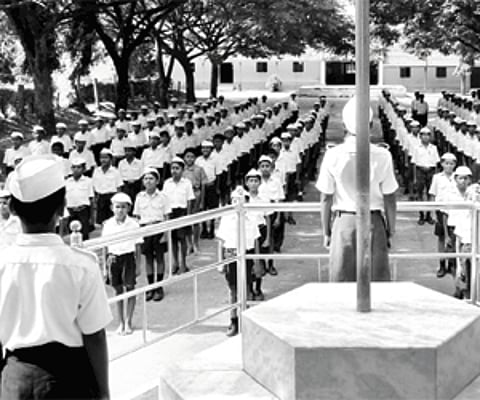
Discipline is the first lesson in this school. The students wear Khadi white shirt and topi and wash their clothes daily. Every student works in the fields, farm and the dairy. They are taught yoga too. They also take part in mass prayers compulsorily.
The school is being run by Gudleppa Hallikeri Smaraka Pratishthana.Honourary Trustee of the Prathishtana Dr Deenabandhu Hallikeri says setting up a school is not just about constructing physical infrastructure in the form of building classrooms, libraries and laboratories.
“It is mainly about setting up special methods in teaching to provide every student a full packet of education,” he feels.
Senior Coordinator of the Prathisthana Gopanna Kulkarni says teachers are concerned about children’s progress at each stage of their education like their parents.
President’s award winning teacher S R Patil is the head master of the school. “This type of unique education is rarely found in schools nowadays,” he says proudly.
“The education taught in this school has helped a lot to start agriculture education in my system,” Model farmer Basanagouda Patil of Harthi village in Gadag district, is an alumni of the Gurukul, says.
Farmers Somashekhar Bannimatti of Hullala, Kotresh Inalli in Haveri taluk, Maruti Karegar Chikabasur of Hangal taluk and Sanjeeva Reddy of Magadi village, all alumni of the Gurukul, are still following the methods taught at the school.
In a nutshell
■ ;The main objective of the Gudleppa Hallikeri Gandhi Grameen Gurukul is “learning to become self-reliant following Gandhian way of life”
■ ;All students of this Gurukul are pursuing basic education. The school offers free education from 5th to 10th standard in state syllabus
■ ;Apart from class room teaching, the students are busy in practising different types of agricultural activities in fields like farmers to become self-employed after 10th standard
■ ;The Gurukul was established on October 2, 1984 as a brainchild of Gudleppa Hallikeri in 32 acres of land at Hosaritti village
■ ;The school has recorded 90% results and 10 times it has achieved cent percent results
