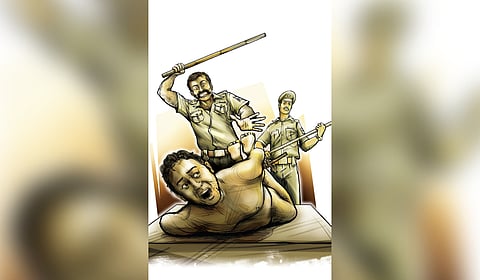

THIRUVANANTHAPURAM: If Article 21 of the Constitution states that no person can be deprived of their life or personal liberty unless in accordance with the law, the saga of custodial torture in the state speaks of a deep-seated infringement of basic human rights and dignity.
From being spread-eagled in dark rooms and thwacked relentlessly using batons or sticks, to rolling heavy pipes over bodies and beatings with cloth-wrapped iron objects ... the horrors don’t stop there.
The torture and mental anguish, that only those who have endured it can totally comprehend, open a window to the custodial highhandedness of law enforcement that frequently leads to loss of life. Police can keep a suspect in detention for up to 24 hours or with the court’s permission, for 15 days. And it is distressing that the excesses are played out in this short span of time.
Shameer, Rajkumar, Sreejith, Vinayakan, P P Mathai, Ranjith Kumar, Suresh to the most recent case involving Tamir Jifri: the names of victims may vary, but the tale remains hauntingly familiar.
When persons are booked for any offence they are placed in state custody. And the state and its machinery are responsible for their safety throughout the legal process. How then can law enforcement act as both judge and arbiter of fate? The counter is often: ‘Don’t teach us the law.’ While statistics may document deaths, there is no measure of the trauma inflicted by torture.
For victims, it can seem like a death sentence -- each passing day more brutish than the last as they await their fate, removed from the rest of the world. The experience is equally agonising for their families – at a physical, emotional, and psychological level.

“Custodial deaths are heinous crimes. People taken into custody are the responsibility of the state. It is the primary duty of the police to ensure the safety of the person in their custody. It is deeply disturbing that the number of cases is rising,” says former chief justice of Patna High Court and former chairman of State Human Rights Commission, Justice J B Koshy.
The National Crime Records Bureau (NCRB) data tabled in the Lok Sabha last August shows that there were a total of 16 custodial deaths reported in Kerala between 2016 and 2024.
The first Pinarayi Vijayan government, which took office in 2016, took severe flak over incidents of custodial torture, which showed the home department, which oversees the police force, in poor light.
The incidents were spread out, with no set pattern. While two cases were reported in 2016-17, there were none in 2017-18. This was followed by three cases in 2018-19, and two in 2019-20. This dropped to one in 2020-2021, before a spurt of six cases in 2021-22. Between 2022 and 2024, two cases were reported.
“People become unnecessary targets and channels for officialdom to vent their frustration. To maintain control, an effective director general of police (DGP) is essential. However, police associations at times hinder their duties. With the backing of the ruling dispensation, these associations often suppress cases. Another problem is the absence of a committee to address police concerns. They face excessive political pressure, financial constraints, and a shortage of civil police officers (CPOs), leading to increased workload and frustration. This unfortunately spills out into the public. While not justifiable, these are the underlying reasons,” Justice Koshy points out.
This poses a key question: who will investigate criminal cases against law enforcement? Thorough probes into custodial deaths have been far and few in between and convictions have been even sparse. There were over 40 injuries on the body of 31-year-old Shameer, who died on October 1, 2020, at a Covid quarantine facility following an alleged assault by police. Six jail officials were arrested by a crime branch special squad. But after posting bail, each of them were allowed to return to their jobs.
Rajkumar, 49, of Nedumkandam, Idukki was subjected to police torture for four days in June 2019. Among the torture methods employed was ‘falanga’, which involves repeated beatings on the soles of the feet or the palms of the hand. The CBI charged nine police officers. An appeal filed with the Kerala Administrative Tribunal (KAT) ensured that they were not even fired.
An autopsy conducted on 26-year-old Sreejith, from Varapuzha, who died in April 2018 reportedly as a result of abuse in custody, revealed injuries to the abdomen that resulted in multiple organ failure and his eventual death. Ten police officers were suspended. They were all reinstated in December 2018.
Mathai of Chittar was found dead in a well after being taken into custody by a forest official in 2020. It is being probed by the CBI.
Jifri, 30-year-old, one of the five youths caught by the Tanur police in a drug trafficking case, died last August 1. The postmortem report revealed 21 wounds on his body and swelling in his lungs. The body also had many problems connected with regular drug use. On August 2, eight policemen including the sub-inspector of Tanur police station were suspended pending inquiry. A week ago, four police officers were arrested.
“Not all deaths in custody should be labelled as custodial deaths. Some die by suicide, others succumb to heart attacks due to panic, while some are highly intoxicated upon arrival in custody and experience withdrawal symptoms leading to death. In comparison to states like UP, Bihar and Maharashtra, Kerala reports significantly fewer custodial deaths. In many instances, there is no evidence of police torture,” says Alexander Jacob, former jail DGP.
When those entrusted with upholding the law resort to behaving like goons, it not only undermines the very foundation of justice.