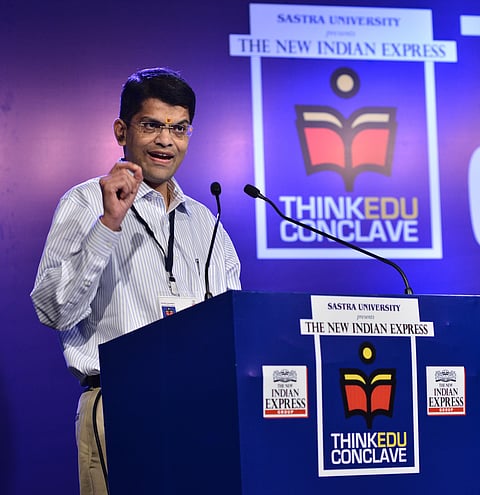

CHENNAI: The rural-urban divide and the need to bridge it, was the key issue that came up at an ThinkEdu Conclave panel discussion featuring speakers hailing from backgrounds as varied as village administration and academia.
“Though we are a third world country, the idea of villages is not third class. We cannot museumise rural India, rather, we should be extending them to a larger eco-system to extract the intellectual gold mine hidden in rural India. We should be empowered to give degrees to open air universities running in rural India in order to integrate them into formal education,” stressed, S Vaidhyasubramanian, Dean (Planning & Development) SASTRA University. In an extension of this point, the panel’s chair K Vaidyanathan, editor of Dinamani, highlighted the skeletal funding provided to schools and colleges in the rural areas. “The automobile firm Mahindra had donated 10 million to the Harvard University, but if only 10 per cent of the amount was ploughed in India, greater innovation could have been brought to light,” he said. Underlining the existing bias in the education system, he spoke on the hypocrisy of parents.
“Parents want to send their children to schools with good teachers, but don’t want their children to become teachers. The parents who are illiterate want to send their children to barebone private schools though they are qualitatively not better than state-owned ones. What kind of education are we imparting. With this kind of school education how are we going to compete ?,” he asked.
The reason for the decline in quality of education and its superficial nature could be be attributed to several factors but one that was particularly true, said Vaidhyasubramaniam. “The school curriculum is decided by bureaucrats and academics in their second innings, sitting in air-conditioned rooms and intellectually cut off from the educational situation and we are mandated to follow the curriculum. As a result, we miss capturing the knowledge hiding in our villages,” he explained.
Around 54% of the rural population is literate according to the 2011 census. A number of first-generation learners will demand access to higher education. “Everybody wants to become an engineer but this demand for education is not going to be even. We will be challenged between disparities between those who have a better lifestyle, rural population and those who do not,” he said. The panelists termed this rural influx Taramani Syndrome, the phenomenon where students from rural areas are educated in cities and end up in MNCs just to scorn at their roots.
