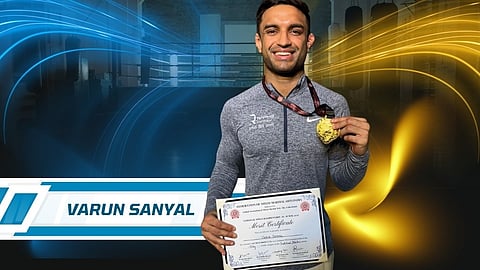

Like many boys of his generation, Varun Sanyal, too, spent his childhood watching WWE. The world of scripted smackdowns and oversized showmen was magnetic to a young mind growing up in Singapore. But it was one wrestler in particular who left a mark – Brock Lesnar.
Varun’s first brush with real combat sports was when Lesnar transitioned from WWE theatrics to the more punishing octagon of the UFC. But it wasn’t until much later that Varun felt that kind of thing might apply to someone like him.
Indeed, watching Indian wrestlers like Sushil Kumar and Yogeshwar Dutt succeed at the 2012 Olympics sparked something deeper in Varun. “They looked like us. From India. Doing well in a global sport. That really changed something for me,” he tells TNIE.
He wanted in. But his father didn’t. Combat sports were out of the question. "Shot the idea down immediately," Varun laughs. So he waited.

Years later, in Singapore's mandatory National Service, he was earning his own money. With a small but steady income, he made a decision: he paid for a full year of combat sports training upfront. "If I was going to take this leap, I wasn’t going to do it half-in, half-out."
Varun’s relationship with sport had always been serious. Cricket, football, athletics, squash, and even powerlifting. He’d done them all. Cricket, especially, had become more than just a game. "It helped me stay connected to India. It gave me a community.”
But cricket was something he did because his friends did. Combat sports, on the other hand, was something that chose him.
He learned quickly how serious the choice was. In his very first week of training, his coach paired him with a woman half his size. "She flipped me over her head. Tossed me around like I weighed nothing," he laughs. "I’d never felt so helpless."
But that, he says, is the beauty of sport. Especially this one. It humbles you. "You show up thinking you're strong, and you get dismantled. It either breaks you, or builds you."
For Varun, it was the latter. He trained relentlessly, squeezing in sessions between the physically exhausting hours of military camp. His parents knew he was training, but assumed it was casual. Evening workouts, a fitness hobby. They didn’t know he was heading to the gym twice a day, every day, chasing the kind of discipline that few outside the fight world understand.
Soon, he began competing. He found success in jiu-jitsu and wrestling tournaments, picked up medals, and earned a reputation for being the guy who always showed up.
Then came the UK. Varun moved there for university, but he also knew this was one of the hotspots where MMA was truly taking shape as a sport. "In Singapore, I trained the components: Muay Thai, jiu-jitsu, wrestling. But MMA isn’t just the sum of its parts. It’s its own sport. Just like a triathlon is more than swimming, biking and running,” he explains.
Varun began training under Stuart Austin at Fight Zone London and realised he had to unlearn much of what he had thought was effective. "In jiu-jitsu, being on your back is fine. In MMA, you get punched in the face for that. That shift in mindset took time," he says.
The results began to speak.
In 2022, he made his amateur MMA debut. A high-profile fight in the UK with a global audience. He won decisively. That same year, Varun won his first major domestic title in India – the West Zonal Championship. He won gold.
The following year, i.e. 2023, he raised the bar even higher and clinched the precious metal in the national MMA Championship. He repeated the feat in May 2025 by bagging yet another gold and cementing his name as a force to reckon with in Indian MMA.
Today, he holds a 12–3 record, though popular MMA database Tapology still reflects an outdated 4–3, omitting his wins in India. "It affects perception. Sponsors, media, all look at those numbers," he points out.
In addition to these feats, Varun has also represented India internationally at IMMAF events, fighting some of the toughest talent from across the world.
But for Varun, the fight is bigger than the belt. It's about representation. "For a long time, when Indian teams showed up at global MMA events, people saw us as warm-up matches. Now, we’re winning. And suddenly, it’s, 'Oh, the Indians are here to win.' That shift matters."
His battles aren’t just inside the cage. Back home, MMA is still viewed with scepticism. "People see it as violent, something for rough types. There’s no mainstream respect," Varun points out.
But he argues that MMA has ancient roots in Indian culture. "We had Malla Yuddha. Striking, grappling, joint locks. It’s all there. We just called it something else. Colonialism wiped that out. Now, the UFC packages it, and we think it’s American."
He compares it to yoga. "Same thing happened. Our own people mocked it. Then the West adopted it. Now it's boutique fitness,” he says.
Now, each time Varun enters the cage, he sees it as a statement. "India is here. Not just to participate, but to take the fight to the world."
He draws strength from role models like Virat Kohli. "That Australia tour, where Kohli flipped off the crowd and then came back with a century. That fire, that pride, that defiance. That’s the new India. That’s what I want to represent."
Yet, it’s not easy. MMA is a lonely pursuit. The injuries are constant. Recovery takes discipline. "After a fight, I take one or two weeks off completely. Sleep, hydrate, eat. Only then comes training. If you sit out every time you’re hurt, you’ll spend half your career recovering,” Varun says.
Outside the cage, Varun loves food. Not just eating, but cooking, reviewing, comparing ingredients across cuisines. "If I wasn’t fighting, I’d probably be a food reviewer. I even use an app to log restaurant ratings."
But when it comes to fighting, there’s no hobbyist angle. "This isn’t something you do part-time. You step into that cage half-committed, you get knocked out."
He understands the weight of legacy too. His father, Sanjeev Sanyal, is a historian and policy advisor. The Sanyal and his mother’s Barua lineages include freedom fighters. "That wasn’t why I started. But now, it gives me a sense of purpose. It feels like I’m continuing a tradition of representing India, in a very different kind of battle,” Varun adds.
He sees fighting not as aggression, but as decision-making under pressure. "It teaches you to commit. In life, if you hesitate, you lose. Fighting strips away the fluff. It makes you decisive," he says, urging all to pick up the sport, even it is just to remain fit.
Today, Varun trains between India, Singapore, and the UK, blending philosophies from each. In between mentoring younger fighters and working to build a stronger MMA ecosystem in India, he is preparing for his next big fight in September. Now, sponsors, too, have slowly started showing interest. Today, he is supported by Raphe mPhibr, an Indian drone company.
"India’s not there yet in MMA," Varun notes. "But soon. We’re getting there." Indeed, and when we do, Varun Sanyal will be one of the reasons why.