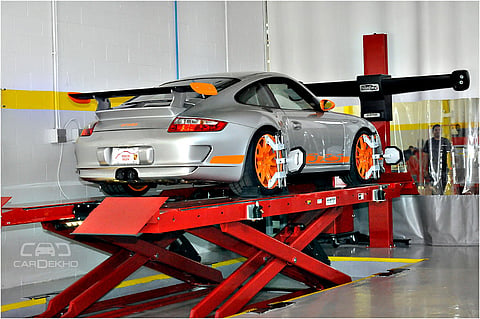

Very often while driving many of us realize that we are no more able to control the steering wheel and our car either flows at right or left side despite efforts to keep the steering wheel in straight line. In these circumstances you would have felt that the car is demanding extra efforts to put steering wheel straight. The reason behind such situation is nothing but a faulty wheel alignment in your car. This term might bounce over people’s head, but this is a crucial thing to understand in order to keep the overall health of the vehicle good.
Let’s understand what is wheel alignment - It is a simple process of regulating the rear and front suspension of a car so that the vehicle wheels stay in the specified toe angle. The apt toe - angle ensures that there is no irregular irksome on tyres and the handling of the car remains fit. Here you might ask what are the reasons behind faulty suspension in the cars? For that you must know that commuting the car on pothole, having an accident, are some of the causes of imbalanced suspension.
The importance of wheel alignment can be felt in the way that skewed wheels cause wear and tear of the tyres. The proposed alignment of the car not only lessens the tyre wears but also adds to the comfort of passengers. It also improves their performance and life along with ensuring better handling and constancy.
The checking of car’s wheel alignment can be done in following cases-
Whenever you feel a jagged wearing of tyres or when you fit in new tyres.
When you hit hard on any rock or pothole and when you change the parts of suspension.
When the steering wheel of your car is demanding extra stress.
The process of correcting the wheel alignment is not a tough task. The professional will do this work for you in mere 30 minutes. They primarily adjust three parts naming - toe in / toe out and camber. Camber is the tilt angle of wheel. If the wheel bends too far then it might cause uneven wear. The camber angle of each vehicle is designed and adjusted accordingly to ensure good tyre behavior on the straight as well as during turns. There should be optimum difference between camber angles, if the disparity is too much, the vehicle will lean to pull one side.
Coming to the Toe- it is the difference between the rear and front of the wheels on the same axis. It basically identifies the course of the tyres in terms of the central line of the vehicle. The setting of toe affects the straight line steadiness and handling traits of the vehicle. There are two conditions in toe. While toe-in suggests the closeness of front of wheels on the axle than the rear of the wheels, the toe-out describes just opposite situation. In the situations of too much Toe-in, the tyre trample tends to wear more on the outer rim, in the event of toe-out; the tyre tread tends to wear more on the inner angles.
Toe-setting should be reasonable as too much setting will cause drivability problems and this is most felt during rainy season. This happens because of tire grooves on highways. Whenever any of the front tyres stumble upon a pedal on such groove, it drops some of its grasp and due to this; another tyre’s toe setting will thrust causing extreme toe-in, or pull causing unnecessary toe-out. This may make the vehicle to feel unbalanced.
So, this was all about wheel alignment. As said earlier a balanced wheel alignment will improve the fuel efficiency of your vehicle along with increasing tyre’s life.
