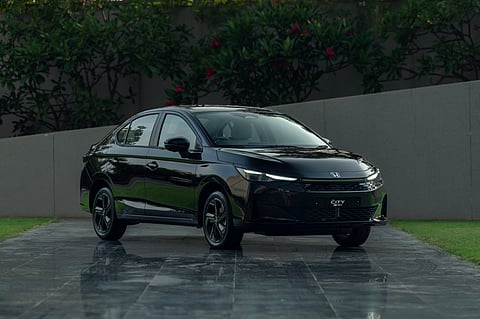

For over two decades, the Honda City has remained the benchmark in India’s mid-size sedan segment. Even as SUVs dominated the market, the City managed to retain its appeal through a blend of elegance, comfort, reliability and driving refinement.
Six years after the launch of the fifth-generation model, Honda has now introduced a comprehensive update to keep the sedan fresh and competitive. Here are my impressions:
EXTERIOR
Without altering the character of the elegant sedan, Honda has given the City a sharper and more contemporary look. The thick chrome bar at the front has made way for a connected light bar, a honeycomb-pattern black grille and sleeker headlamps.
The Honda logo is now positioned above the light bar at bonnet level, lending the front fascia a cleaner appearance.
The tail lamps have also been mildly redesigned, while the new dual-tone alloy wheels add freshness to the profile. The sportier styling has increased the overall length of the car by 3.4cm.

INTERIOR
The cabin remains familiar but now comes in a black-and-ivory theme. The dashboard houses a larger 10.1-inch touchscreen, complemented by a new silver-textured trim strip.
The front seats are supportive and ventilated, but the electric adjustment option is still missing.
Rear-seat comfort continues to be one of the City’s strengths, offering generous legroom and adequate headroom. However, the rear headrests remain non-adjustable.
Dedicated rear AC vents, Type-C charging ports, a rear windscreen sunshade, and an armrest with cup holders add to passenger comfort.
Storage spaces are plentiful. The petrol version offers a 506-litre boot, while the hybrid sacrifices some luggage space to accommodate the lithium-ion battery pack beneath the floor.
A 360-degree camera system has been added, but its utility is limited by the display’s average resolution. The upward-angled touchscreen also tends to catch sunlight, affecting visibility under bright conditions.
Other notable features include an eight-speaker audio system, ambient lighting, wireless Apple CarPlay and Android Auto, wireless charging, connected-car technology, a sunroof and an electronic parking brake.
POWERTRAIN
The Honda City continues with its proven 1.5-litre four-cylinder petrol engine producing 120 hp, available with either a six-speed manual gearbox or a CVT automatic.
The hybrid variant combines a 1.5-litre petrol engine with two electric motors, delivering a combined output of 125 hp through an e-CVT transmission. My test drive was in this top-spec hybrid version.
The strong-hybrid system operates in three modes — Electric, Hybrid and Engine — automatically switching between them depending on driving conditions to optimise performance and efficiency.
At low speeds and during idling, the car runs in EV mode. During strong acceleration, Hybrid mode engages, drawing power from both the engine and electric motor. At cruising speeds on highways, the engine directly drives the wheels.
The transitions between modes are smooth and seamless, aided by the refined e-CVT gearbox. Honda claims an impressive fuel efficiency figure of 27.26 kmpl for the hybrid. In comparison, the petrol version delivers a claimed 17.77 kmpl with the manual transmission and 17.97 kmpl with the CVT.
DRIVE AND HANDLING
The City continues to appeal to buyers who prefer composure over drama. Its suspension setup, steering precision, braking performance and high-speed stability remain among the best in the segment.
Ride quality is comfortable and confidence-inspiring, though cabin insulation could have been better at higher speeds.
PRICE & VERDICT
The updated Honda City is priced between Rs 12 lakh and Rs 21 lakh. The top-end petrol variant costs around Rs 17 lakh, making it about Rs 4 lakh cheaper than the hybrid version.
This price gap is perhaps the biggest hurdle. However, for buyers prioritising fuel efficiency and whose usage patterns justify the investment, the City Hybrid remains a compelling option.
The drawback is that the hybrid is available in only a single variant priced at `21 lakh (ex-showroom). At this price point, the mediocre infotainment and camera systems, along with the lack of electrically adjustable front seats, fall short of expectations.
That said, the City continues to be a reliable, elegant and contemporary sedan. Honda has also strengthened its safety credentials by incorporating ADAS features, which are well calibrated for Indian driving conditions and work with minimal intrusiveness.
Torque talk
MG MAJESTOR LAUNCHED
SW MG Motor India has launched the Majestor, billed as India’s first D+ SUV. The 4x2 automatic top trim is priced at Rs 40.99 lakh (ex-showroom) in both six- and seven-seater configurations, while the 4x4 automatic top trim costs Rs 44.99 lakh (ex-showroom) and is available only as a seven-seater. Power comes from a twin-turbo diesel engine producing 215.5 PS and 478.5 Nm, paired with an eight-speed automatic transmission. The intelligent 4WD system offers 10 off-road modes, while the SUV also features first-in-segment triple differential locks (front, centre and rear)
Maruti flexes it up
On the eve of World Environment Day, and in line with the vision of Atmanirbhar Bharat, launched India’s first flex-fuel car. A flex-fuel vehicle can run on any ethanol-petrol blend ranging from E20 to E100, giving customers greater fuel flexibility. Maruti Suzuki has introduced this technology in the Wagon R, with CNG and LPG variants already in its portfolio.NEXT-GEN TIAGO & TIAGO.EV
Built on a decade-long legacy and the trust of over 700,000 customers, Tata Motors Passenger Vehicles has launched the next-generation Tiago. Available in petrol, iCNG and electric powertrains, the hatchback is priced from Rs 4.69 lakh for the ICE version and Rs 6.99 lakh (full ownership) for the electric variant. The new Tiago combines practicality, modern technology and value, while offering customers a choice between conventional and electric mobility under a common design philosophy.