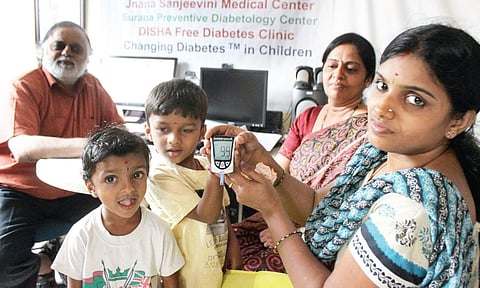

BENGALURU: Five-year-old Diganth R, unlike other children of his age, is not scared of needles. He is insulin-dependent. At Jnana Sanjeevini Medical Centre in JP Nagar, he sits obediently with his 25-year-old mother Shilpa N on a Saturday afternoon for his routine checkup. He has to be administered insulin four times a day, and Shilpa and her husband, who reside on KR Road, cannot afford two bottles of insulin every day.
They have a small pani puri shop to sustain their family of four. For thirty years now, Jnana Sanjeevini Medical Centre of the Samatvam Trust has been a go-to place for poor diabetics who can’t afford the rich man’s disease. The centre provides free insulin to children and medicines to adults. It has provided scholarships to children from school to college, around 40 of them. The centre is run by Dr S Srikanta who is a researcher in the field of endocrinology. He has been faculty at the Harvard Medical School and clinical investigator of National Institute of Health, USA.

A month of diabetes medication requires at least `4,000, provided there are no complications. Diabetics are prone to heart, kidney and eye problems. Those with severe diabetic foot also have to undergo amputations. To prevent this, Srikanta has trained around 18 community health workers who go around Ramanagara district to diagnose diabetes and either ask them to go to a primary health centre or visit Jnana Sanjeevini.
Dr Srikanta has touched the lives of one lakh families in the past three decades. The rural project is called Madhura Sanjeevini. These 18 barefoot doctors aren’t even educated let alone have rudimentary medical education. But they do know that blood glucose levels between 100 and 125 when fasting is bordering diabetes and needs changes in lifestyle or medical intervention.
They are armed with a kit with essentials to diagnose diabetes — sugar meter, weighing scale, and a mobile with a software loaded on it. “When it indicates green, they know that the blood glucose is normal. When it shows yellow, they understand that the levels are worrisome and advise people on exercise or changes in diet, etc. When it reflects red they know that the levels are more than 125 on fasting blood and that they need to see a doctor,” says Dr Srikanta.
Everyone reports to Rathnamma Srinivas. They maintain a register of their attendance and the houses they’ve covered. One thing that binds all of them is that someone in their family is a diabetic and has suffered the implications of it. So far they have screened at least 2,900 citizens.
“One-third of the patients who come to our centre pay, another one-third get subsidised treatment and one-third don’t pay,” says Dr Srikanta. Building the four-storeyed charity structure wasn’t easy. Their benefactors include the GC Surana family of Micro Labs, Sarojini Damodaran Foundation, Infosys Foundation, Biocon Foundation, Sahayata Trust and other institutional and individual donors.
Srikanta’s dream, however, is to take healthcare to the doorstep of the urban poor and rural poor. “Everyone should learn how to diagnose diabetes, from the office clerk to a doctor,” he says.