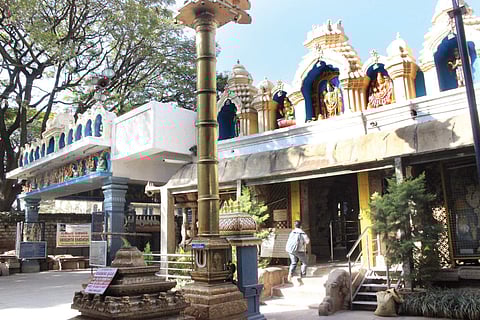

BENGALURU: You’ll soon be ‘flying’ past a 300-year-old temple, once the construction of the green line of Namma Metro connecting Majestic and KR Market is completed.
Located opposite to the Bangalore Medical College, Kote Sri Prasanna Venkataramana Swamy Temple is a Vaishnavite temple, dedicated to Venkateshwara.
History
Though a few records mention that the temple was built in 1689, independent historian and researcher Arun Prasad says, it cannot be right as the temple was built after Bengaluru was acquired by the Wodeyars in 1690.

He says, “Bengaluru was under the rule of the Marathas in 1680. Chikkadevaraja Wodeyar showed interest in acquiring the city from the ruler Venkoji but before the deal was finalised, it was captured by the Mughals in 1687. Three years later, Bengaluru was sold to Wodeyar.”
Dated 1704, the Kothanur inscriptions on the outskirts of the Kothanur village says that Kanthirava Narasaraja Wodeyar is the son of Chikkadevaraja Wodeyar who raised a mud fort and built the temple. The mud fort was an oval fort erected towards the South of the Kempegowda fort.
It was referred to as pete fort.
Arun Prasad says, “Chikkadevaraja Wodeyar was a devotee of Vishnu. To commemorate acquiring of Bengaluru, he built the temple. The temple was equidistant from its Mysore and Delhi gates.” Ironically, as the city expands and requires a new metro line, the temple authorities are worried that the construction work will damage this ancient token of gratitude.
It is said that on October 15, 1811, the Maharaja of Mysore, Mummudi Krishnaraja Wodeyar first performed the pooja at the temple before conducting a special durbar at Tipu Sultan’s Summer Palace. The palace, constructed by Hyder Ali and Tipu Sultan, is located just behind the temple, which stands as a testimony to the religious tolerance. Records also suggest that Tipu and Hyder have also made donations to the temple.
The temple stood as a defence for the palace during the Third Anglo Mysore War in 1791, led by Lord Cornwallis. The inscription about the history of the temple, placed inside the temple, reads when the bullet was aimed at Tipu, it hit the Garuda Gamba, thus saving his life. Garuda Gamba was a tall octagonal pillar in front of the temple, at its entrance.
Arun Prasad adds, “When Bengaluru was attacked, the temple suffered damage. The pillar developed a crack in the centre on being hit by a cannon ball. The crack was clearly visible. The structure had collapsed a few decades ago and it was replaced by a new one.”
One of the information boards in the temple reads that Garuda Gamba was an 80-feet tall, with eight moolahs and was set on a narrow footpath.
Architecture
The temple is built in Dravidian style. The stone walls around the sanctum-sanctorum have relief sculptures that depict Girija Kalyana (wedding of the popular mythological characters Shiva and Parvati, who also goes by the name Girija) and have idols of Brahma, Vishnu, Maheshwara, Saptha Rishis, Saptha Matrukes and Ashta Dikpalakas. There are huge pillars with intricate carvings of Navaranga sculptures.
Arun Prasad adds, “The main idol of Venkateshwara is placed in garbhagriha, the sanctum sanctorum. Outside the garbhagriha, is the mukti mandapa which has sculptures with Yali works, a significant feature of the architecture in the Vijayanagara temples.”
To the south west of the sanctum-sanctorum is Anjaneya temple and to the north west is the Mahalakshmi temple. The Tulsi Vrindavan in the temple is also considered to be sacred.
The Navagrahas were added after the renovation of the temple. The foundation stone for the renovation was laid by Rangaswamy Bhattiar, a descendant of family of priests who have been associated with the temple for nearly two centuries now.
Special Occasions
The main festival celebrated at the temple is Vaikuntha Ekadashi when thousands of devotees come to the temple for blessings. The annual car festival is also very popular. The Rathotsavam falls in Vrushabha Masa, around May-June. The deity is seated on a silver chariot and taken in a procession around the temple.
The temple also conducts Srinivasa Kalyana Utsavam, four times a week.