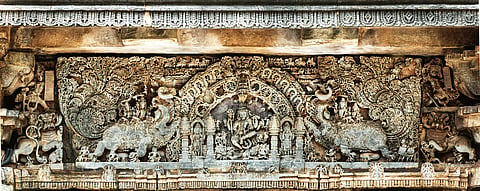

BENGALURU: Sculptures might be just art to many of us but, to Pundalik Kalliganur, they also convey a story. In his book, Belur-Halebidu Shilpakala Samrajya, he has documented sculptures that are at Chennakesava Temple in Beluru and Hoysaleswara and Kedareswara temples in Halebidu. “These sculptures reflect the beauty of Hoysala architecture. They are said to be the best in the entire country,” he says. The Hoysala Dynasty constructed 965 Shiva temples, 295 Vishnu temples and 73 Jain temples.

Hoysalas ruled the present state of Karnataka, minor parts of Tamil Nadu and parts of western Andhra Pradesh and Telangana, between the 10th and 14th centuries. The capital of the Hoysalas was initially located at Belur but was later moved to Halebidu. According to the book Chennakesava Temple was built in 1117 and Hoysaleswara Temple, in 1120.
His book, in Kannada, has a sculpture carved on an outside wall of the Chennakesava’s sanctum sanctorum on its cover page. As you open the book, you see beautiful line drawings of the same sculptures. Every chapter opens with a line drawing.
These were made by Pundalik during his visit to the temples. The freelance illustrator says, “Before deciding to capture the sculptures on camera, I thought of making line drawings of each of these. I started that work in 2012 but they were not perfect. That’s when my son said that maybe I could photograph the sculptures instead of making drawings of them.”
Pundalik wanted an expert hand and so he hired Vipin Baliga, a professional photographer, and directed his shots. “I am the curator of the book,” says Pundalik.
To capture finer details, Pundalik and Vipin went immediately after rains because “rainwater enhances the look of the sculpture”. “Rain cleanses the sculpture and highlights every inch of it,” he says. The 1,996 photographs in the book are proof. He befriended the locals who alerted him whenever they expected a rain.
Many photographs capture details and not the entirety of a sculpture. In one, we see only a figure’s legs and, in another, the focus is on the pearls hanging from the ornaments. The pearls appear delicate, even when carved out of a hard stone. “That is the perfection the sculptors maintained,” he says.
Every picture in his book is followed by a story about the sculpture. One of the figures is of Natya Rani Shantala, who is believed to have been a dancer in Vishnuvardhana’s court. “He was carried away by her beauty and married her,” says Pundalik. Vishnuvardhana’s first name was Bittideva. He took over the empire in 1108 and changed his name to Vishnuvardhana when he adopted Vaishnavism on the advice of Ramanujacharya around the same time.
Most of the sculptures have about six layers and is carved from a single stone. One sculpture, in Belur, he says talks of the way teenagers perceive love. It shows a man standing with a woman whose face resembles that of donkey’s. “The sculpture tells us that love, in that age, is blind,” he says.
Another sculpture is of Shiva when he was born. “According to the Rigveda, Shiva was born with one leg. Brahma and Vishnu were born out of him. He later assigns them the task of creating the universe,” says Pundalik.
He has dedicated one chapter in his book, titled ‘Bhagna Sundari’, to broken sculptures. “I want people to feel the need to maintain a heritage handed down to them,” he says.
He will soon be releasing an English version of the book. The current, Kannada version costs Rs 1,450 and is published by Kikkeri Publications.