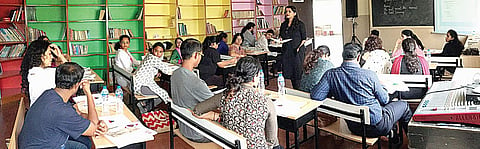

BENGALURU: A team of renowned dancers, musicians and visual designers have developed a curriculum to complement regular academics with lessons in art. TFAI (Teaching For Artistic Innovation) offers online resources to develop children’s creative abilities. The programme has been curated by a panel of experts including Mayuri Upadhya, a popular choreographer, and Gaurav Vaz, bass guitarist for The Raghu Dixit project.
Lina Vincent, an art historian and curator, adds, “Often lesson plans are random and dependent on a teacher’s personal commitment... The Visual Art and Design curriculum introduces students to age-appropriate skills, techniques and aesthetic concepts.” It was launched by Uzma Irfan, director of Prestige Group and founder of Sublime. Mayuri says, “Dance is not only about form and the way your body moves. It is creative analysis”.
Interactive lessons
The syllabus comprises both practical and theoretical approaches. “I have compiled videos of some of the world’s best dance companies... It includes a lot of interactive learning,” she adds.
The curriculum for theatre is structured on the basis of several themes – exploration (body, balance, movement/beat), expression, interaction (with two or more individuals/props, synchronicity and timing), narration, imagination/creation (fantasy and abstractions) and co-creation (Showcase).
Anita Mithra, chief programme designer, theatre, says, “There is no fixed evaluation method or result. Process-centred theatre necessitates doing and involving students mentally, emotionally, socially, and physically,” says Anita.
The team creates a structure and combines it with teacher training and uses some core theatrical tools or principles, she says. Mayuri adds her experience has played a large role in designing the curriculum. “As a child, I was overweight and I would often sit in my classroom in school, lost in my thoughts. I often felt like Alice from Alice in Wonderland, where I would constantly be dancing with imaginary characters. I remember why I would lose interest in my classes in school and that was my starting point for designing the curriculum.”
Sachin Mannath, a musician believes there is no proper curriculum based music education in many schools in India. “When I did my advanced music studies in the UK, I got a chance to see how they teach music,” he says. It was never a specialist approach, but a generalist one that students enjoy, he adds.
How lessons given?
“I also had the opportunity to teach Indian and foreign adult students in the UK as well as in India at a top music conservatory and I found that many of the Indian students lack that childhood exposure in music when compared to the UK students,” says Sachin. The curriculum will be implemented from Grade 1 to 9 in several schools in the city. It had a pilot run with training sessions for teachers from seven different schools in the city.
Gaurav Vaz, bass guitarist for The Raghu Dixit Project says the important thing for children that young is exposure. “We are focussing on bringing out the creative thinking in children and prepare them for a completely unknown world after they graduate,” he says.
