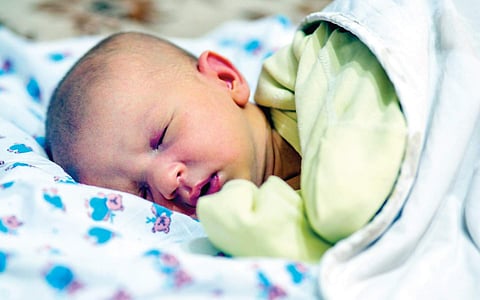

BENGALURU:In the first two days after birth, the baby is closely examined by doctors to see signs of yellow colouration in the eye and face, symptoms of jaundice in babies, which are not uncommon.
Causes
In newborns, the red cells in blood have shorter life span. The dead cells are processed in the liver and if the liver is not able to process the excess dead blood cells, bilirubin rises. In preterm babies – babies born less than 37 weeks, the liver is not mature enough to handle the red blood cells and bilirubin level increases making jaundice inevitable.
Another common cause of jaundice is when vacuum cup is used to facilitate the birth that leads to the swelling in the scalp, thereby causing blood to accumulate. This blood is slowly broken down leading to jaundice.
Also, if the blood group of the mother is Rh negative and baby’s is Rh positive, there are chances that antibodies are formed on exposure to baby’s blood group. This will cause breakdown of the red cells in the baby leading to jaundice. Anti D injections are given by the obstetricians during pregnancy and after delivery to mothers with negative blood group
Another reason is the ABO incompatibility of the blood group. If the mother is in the O blood group and the baby is either A or type B, then there are chances of jaundice development. Premature babies are much more likely to experience severe problems from ABO incompatibility.
Other uncommon causes include infection (urinary tract infection), viral infections, and disorders affecting the liver.
In addition, low levels of thyroid hormones, absence of certain substances in body — glucose-6-phosphatase dehydrogenase and abnormal red cells also causes jaundice.
Sometimes you will also hear doctors saying it is more likely a “breast milk jaundice”. Jaundice caused by this occurs within 4 -5 days and resolves on its own. The breast milk contains certain substance that’s affects the liver ability to process the bilirubin.
Presentation
First the yellow colour becomes visible in the white part of the eye, later over the face and spreads downwards to the abdomen and legs. In most of the babies, yellow is common but babies with severe jaundice will be drowsy and less hungry.
Observe the change in crying patterns, fits and difficulty in waking the baby up. This indicates danger and baby needs immediate treatment. At the same time, the baby needs the attention of the paediatrician to ensure that there are no other clinical indications such
as weight loss.
Tests
If the weight loss is more than 10 per cent of birth weight, the salt levels in blood are to be checked. Blood group and thyroid functioning are tested. Additional tests are conducted if jaundice continues beyond three weeks specially in babies born
before 37 weeks.
Treatment
The purpose of treating jaundice is to avoid the permanent damage to the brain caused by raised levels of bilirubin which is quiet rare. Loss of weight is taken into considerations.
Babies who have turned immune to treatments are given phototherapy, using a blue light treatment, distinct from ultra violet light. The light causes the bilirubin to be converted into soluble form and reduces its level. Baby’s clothing is removed to ensure maximum exposure to lights and eyes are blindfolded to avoid the bright light.
LED Phototherapy, having LED as light source are being used commonly and they are more effective than the conventional Phototherapy. LED lights emit less heat, consume less power and have higher levels of radiance that lasts longer.
If the bilirubin levels are very high, it is not uncommon to use 2 or 3 phototherapy units concurrently. Preterm babies with more than 15 per cent weight loss requires triple phototherapy.
Social Issues
Offlate, babies and mothers are discharged within 48 hours, and this make it essential to assess the babies for jaundice within 1 or 2 days. Cultural and social practices keep mothers from seeing their babies early, which further delays the treatment of jaundice. There us also the myth that keeping mothers from having fatty and oily foods can cure the babies.
There is also a practice of keeping the baby in the sunlight to cure jaundice. The sun exposure in winter will cause drop in baby temperature and in summer UV rays will damage the skin.
Ensure good amount of breastfeeding and give treatments at the earliest.
What is Jaundice
Jaundice is the yellow coloration noted in the white part of the eyes and the skin. In medical term it is called Neonatal Jaundice. In most babies the jaundice manifests in a day or two after birth and gradually decreases over a course of two weeks. The jaundice which occurs between 48 to 72 hours is called physiological jaundice which is normal and common in almost all newborns. The jaundice which occurs within 24 hours of birth is called a pathological jaundice and it is concerning.
The substance bilirubin which causes the yellow color is processed in the liver. Jaundice is noted when a bilirubin builds up in the blood. Normally every one of us have bilirubin present and the liver is the storehouse and factory. Normally bilirubin is converted in another form, which is water soluble and is easily discarded from the body. Bilirubin, at minimal level is not dangerous and no yellowness is seen. As the level of bilirubin rises, eyes turn yellow first and later spreads over the face, chest and abdomen.
The author is a medical director of Kangaroo Care Hospital, Vijayanagar Dr Ramapriya Kalkunte