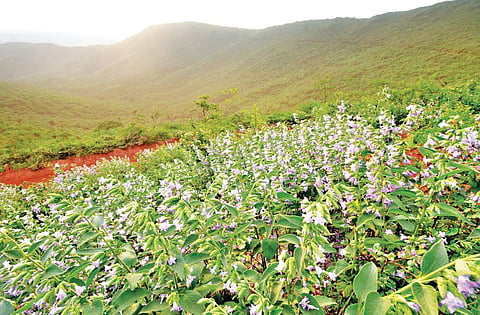

BALLARI: Once in a blue moon, the green hills in the Western Ghats of Nilgiris turn a purplish blue. But this time round, much to the delight of environmentalists and visitors, the mineral-rich plains of Sandur in Ballari district have been taken over by this 12-year-wonder: Neelakurinji. The flower, whose scientific name is Strobilanthes kunthianus, is purple-blue in colour and blooms once in 12 years. And that time is here in Sandur.“The region is similar to the Western Ghats. Being an elevated patch, Sandur region has led to several surprising revelations. Kurinji flowers are spread everywhere this year,” said K S Abdul Samad, a local environmentalist. He believes that there might have been an unreported mass floral bloom here earlier too.

Shivashankar Banagar, a nature lover, points out that the floral spread has increased this time compared to the earlier one. Earlier, it was restricted to Ramanamalai, but this year it has spread to various parts,” he said.Thousands of people are making a beeline for Sandur to see the blue spread there. But what is bothering environmentalists is that the enthusiastic visitors are taking a plant each as memento from there. “Many tourists come here to see the beautiful blue carpet and take pictures and selfies, which is fine. But a cause for concern is when they take a plant with them,” said Samad.
Banagar agrees. He said that almost 50 per cent of the flowers from Swamimalai, the place which witnesses the bloom, has been lost due to human interference. “Local nature lovers have installed a board requesting tourists not to tamper with the plants, but it has not been helpful,” he said.Explaining that the flower has a short life, Samad said that the flower withers away and the entire plant dies immediately within a month or two until the next season after 12 years.
“The seeds mature and the plants will die, only to germinate again once in twelve years. During this time, the plant should garner all the energy and grab all the nutrients available as this process will help it to bloom again. This phenomenon is called Masting. It is similar to that of bamboo, which blooms, dies and germinates again. These kind of plants are called Plietesials. If every person who visits such places takes away a sapling, then the flowering cycle will be interrupted,” explained Samad.
WHERE ELSE DOES IT BLOOM?
The plant scientifically known as Strobilanthes kunthianus is a small herb that flowers once in 12 years in few parts of Kerala and Tamil Nadu. It covers the entire grasslands around shola forests of Annamalai, Mudhumalai, Ooty, Munnar, Idukki, and other places. The name Neelakurinji is attributed to the Nilgiri biosphere, where the flower bloomed frequently. The tribals in the region related their age to this flower. In Karnataka, the floral bloom was witnessed at Bababudanagiri and Mullayyanagiri in 2006.
ABOUT THE FLOWER
There are about 250 species of Strobilanthes in the world and about 46 species found in India. This Strobilanthes kunthianus is named after its gregarious blooming around river Kunthi in Silent Valley National Park of Kerala. Other species of Neelakurinji have different flowering intervals, in which the biological clock triggers the plant to flower en masse. The mild fragrance of the flowers attracts lot of insects including honey bees. Honey harvested in the vicinity of Neelakurinji flowering is delicious and has a special aroma.
WHY SANDUR
The Sandur hills are known for their arid plains of black cotton. Sandur hills are a 48-km stretch from the Tungabhadra reservoir in Hospet to Swami hills in Sandur taluk. These mountain ranges play a pivotal role in deciding the climatic conditions of the region. The thick dry deciduous patch in these plains is different from the rest of the ecosystems in the entire plains of Deccan Plateau.