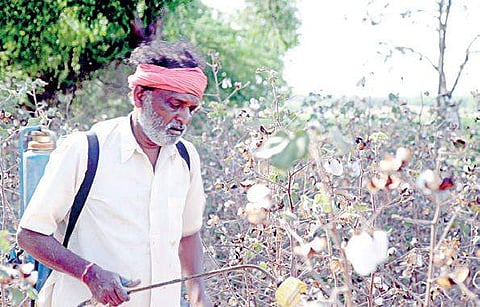

BENGALURU : Do you know the farmer who produced the food you ate in your lunch? Do you whether he/she is still alive?’
This description of Anshul Sinha’s docudrama ‘Mitti- Back to the roots’ jolts one into realising the intensity of the agrarian crisis in India. The feature length docudrama is the story of agricultural scientist Ekta who tries to understand the agrarian crisis and finds solutions. The film’s social message on the poster reads, “Zero farmer suicides-Let’s make it happen”. It is perhaps the first time, the cast and crew undertook a university course and field work to understand the topic.
“The film portrays 27 major issues that drove Indian farmers to suicide and the alternative solutions. Based on true stories, it is filmed in Dorli village which was earlier put up for sale by debt-ridden farmers,” Anshul Sinha narrated. It also centres on Enebavi in Telangana that suffered poor produce due to use of genetically modified seeds and spread of cancer in Punjab from use of pesticides. Ask him why he chose not to make a documentary and Sinha thoughtfully replies, “We want everyone to be able to understand, including children and non-educated citizens. It should not just reach those who have access to YouTube and are literate.”
Mentored by Dr G V Ramanjaneyulu, Centre for Sustainable Agriculture, the crowd-sourced film with 120 individual producers has seen 35 road shows, screenings all over India and abroad including IIT-Madras, Michigan, Stanford Universities. What caused 3.2 lakh farmer suicides in the last 20 years? “High input and low output. There are 24 major crops with Minimum Support Price fixed but government buys only rice and wheat from them. The rest are left to the mercy of traders,” Sinha says.
The other culprit, he points out, is international companies that forced farmers to purchase genetically modified seeds such as of Bt Cotton. “These failed miserably leading to a spate of farmer suicides in Maharashtra. Bt Cotton produced heat in the soil, did not adjust with Indian climatic condition, multiplied ball worm insects, reduced quality and produce,” he adds. The solutions are presented as multi cropping and organic farming. The film is being screened on March 19 by Azim Premji Philanthrapic Initiative and on April 14 by Citizens Agenda for Bengaluru.
