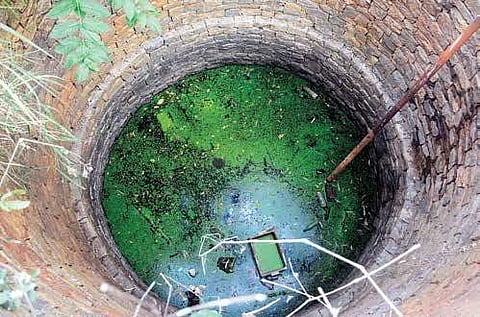

BENGALURU: Traditional wells, which were once the main source of water for Bengalureans, have dried up in the last few years due to the mushrooming of innumerable borewells in the city.Water that was available at just 20 ft below the earth’s surface about four decades ago, can now be reached at a depth of 1,500 ft.

At present, Bengaluru has over 3.6 lakh borewells. Recently, after a joint meeting with members of Karnataka Groundwater Authority, Bangalore Water Supply & Sewerage Board (BWSSB) decided not to permit any new borewells in core city areas. BWSSB has not cleared new borewells since March 1.
Historian Suresh Moona said traditional and open wells were always part of the city’s culture and people used to worship them. The wells were dug scientifically. “In some places, during the monsoon, the wells would overflow. People used water from these wells just like they use water from ground-level tanks in houses. The lakes were full of water and the wells would get recharged. But now, with lakes diminishing and more borewells being dug unscientifically, water table has fallen,’’ he said.
Septuagenarian Dwarakanath, a resident of Hanumanthnagar since 1953, recalled how it took only a month to dig a well manually in the early 1950s. “We used the same well for many decades. It contained water even during summer. But over a period of time, the well started drying up, and we had to close it a couple of years ago. It has become our parking lot now,’’ he rued. Recently, his neighbour who dug a borewell had to drill till 800 ft to strike water.
Sridhar Murthy, a resident of Chamarajpet, said in the late 1970s, during his wedding ceremony, there was sufficient water in the well to cater to the needs of all the guests who stayed with them. “It dried up completely and we closed it in 2011. Last year, when my son got married, we had to hire private water tankers.”
Experts blame the death of wells to over-exploitation of underground water. Water expert Captain Rajarao said urban Bengaluru is one of the most exploited areas for underground water, with 170 per cent usage, but in return, nothing major has been done to recharge the ground water.
“The rain harvesting pits made by authorities are just mere namesake. No one has understood the concept and neither are they being done scientifically,” he added.
Environmentalist N Yellappa Reddy said if recharge pits were made next to Storm Water Drain stretches, rain water which otherwise goes waste could be used harvested. “Even if 50 per cent of this water is recharged, we can get to see water in open wells like before,” he added.