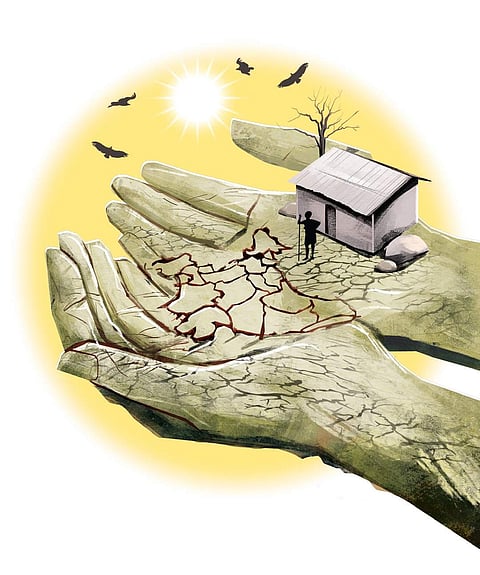

Ironies never cease to exist. After the huge cloudburst over Kerala in the early days of the monsoon, drought and parched crops were the last things on our minds. But nature can be punishing. The Maharashtra government has just declared drought in 151 taluks across 26 of the state’s 36 districts. A premature withdrawal of rains has ensured more than 60 per cent of the crops have been damaged in 112 of Maharashtra’s 358 talukas. Another 39 talukas face crop damage of over 30 per cent.
The situation is equally grim in much of the rest of the country. With an average 9 per cent deficiency in rainfall covering over 200 districts countrywide, about a third of the country seems to be reeling under pretty severe drought. Karnataka and Andhra Pradesh have already declared 23 and six districts respectively as drought-hit. Other states that are struggling between 15 and 36 per cent rainfall deficiency include Gujarat, Rajasthan, West Bengal, Bihar and Uttar Pradesh.
Declaration of ‘drought’ gives temporary relief to rural folk as recovery of farm loans are temporarily halted, land revenue collections waived, a 33.5 per cent concession on electricity bills of agriculture pumps kicks in, and exam fees of students is waived. Also, supply of water tankers at the state’s expense will be pressed in all drought areas for the next six months.
TIGHTENING CYCLE
Water shortage has hit, of all places, Kerala too. Writing in the FirstPost, a former drought relief commissioner, C V Ananda Roy, says, “Reports show that after getting 250 per cent more rainfall than usual in mid-August, the total rainfall in the state plummeted by 86 per cent at the beginning of September. Since the sand beds in the rivers have been destroyed, percolation of flood waters to the ground has been grossly inadequate. The groundwater table has come down. Human interference with wetlands has destroyed our natural sink. The second coming of calamity seems to be imminent.”
The cycle of drought seems to be quickening, with debilitating effect. While there were 10 drought years in the 1950-90 period, since 2000, there already have been six drought years – in 2002, 2004, 2009, 2012 and then just two years ago in 2016. The immediate effect on food production and farm incomes this year is going to be serious. Absence of crucial rains in the September sowing period has meant lower sowing of pulses by 1.1 per cent, coarse cereals 3.9 per cent and cotton nearly 1 per cent. Maize sowing has been hit in UP and Bihar while Rajasthan and Maharashtra are reporting poorer sowing for jowar and bajra. Also, groundnut acreage is down in Gujarat and parts of Andhra Pradesh.
LONG-TERM IMPACT
In the longer term, droughts impact the groundwater level. Frequent droughts compel rural communities to over extract and deplete the groundwater table. This leads to ecological damage such as land subsidence and loss of springs and wetlands, says Chandra Prakash Kala in his note on Lessons on Drought Management.
Agriculture in India, despite the modernisation process, is still largely rain-fed. A World Bank survey a couple of years ago found that of the 160 million hectares of arable land in the country, only about one-third or 58 million hectares (or just about 35 per cent) was “reliably irrigated.” This has restricted multi-crop farming and has not allowed us full food security.
Repeated drought is leading to a bigger problem: over-extraction of groundwater and the permanent depletion of water resources. India has become the largest extractor of groundwater in the world. We use groundwater for 63 per cent of our irrigation needs. More than half our groundwater wells have either dried up or are severely depleted. The latest UNESCO World Water Report says 21 major Indian cities are expected to run out of groundwater by 2020.
Coming back to the immediate, for the incumbent Narendra Modi regime, drought conditions and the clear possibility of a very poor rabi crop this winter make a deadly combination in the run up to the 2019 Lok Sabha polls. Rural distress, which saw the Congress gain a huge chunk of votes in Gujarat where people thought it didn’t have a chance, is a real factor for the coming polls. Higher cultivation costs, mainly on account of higher diesel prices, along with poorer returns because of the slump in commodity prices, have made rural families poorer. Large pockets of drought will only trigger a stampede of discontent the ruling party can ill-afford.
21 major Indian cities are expected to run out of groundwater by 2020, according to the latest UNESCO World Water Report
6 drought years have already been witnessed by the country since 2000, while between 1950 and 1990, it had seen only 10 droughts