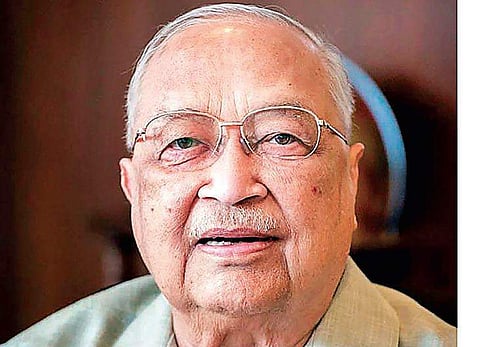

NEW DELHI: Industrialist and Williamson Magor Group (WMG) patriarch Brij Mohan Khaitan passed away on Saturday morning at his residence in Kolkata.
He was 92 years old.
Born in a family of lawyers (Khaitan & Co), Khaitan, however, made his fortune in the tea business and then went on to acquire the Indian business of Union Carbide — Eveready Industries — in 1993, after outrunning the Wadias of Bombay Dyeing in a $96.5 million deal that is also seen as the largest corporate takeover in those days.
It was only recently that Khaitan retired as non-executive chairman from the boards of Eveready Industries and McLeod Russel — both WMG companies — due to old age, but he continued to serve as chairman emeritus in both these firms.
“Members of Indian Tea Association deeply condole the passing away of B M Khaitan... his demise marks the end of an era and loss of a leader and guide for the Indian tea industry,” said Indian Tea Association, of which McLeod Russel is a member.
Initially, Khaitan was a supplier of fertiliser and tea chests to the parent of McLeod Russel.
Later, however, he was invited to join its board, and later he became the managing director of the group, following a crisis that loomed over the company after an investor acquired nearly 25 per cent stake in Bishnauth Tea Company, the flagship in the Williamson Magor Tea Estates.
It was the Khaitan family who provided the money to buy out Bajoria’s stake.
Then in 1987, when the Guthrie family, the largest shareholder in the McLeod Russel Group, wanted to exit India, Khaitan negotiated a deal and finally bought out the estates, thereby making WMG the largest tea producing company in the world.
Later on, under his leadership, the tea company went on to expand its operations in Africa and Vietnam.
However, the WMG companies — Eveready Industries, McLeod Russel, McNally Bharat Engineering and other unlisted firms — are struggling to reduce debt at the group level.
Before his demise, the “evergreen tea man of India” was also mulling selling of the Eveready business in order to raise money to pare the group’s debt.