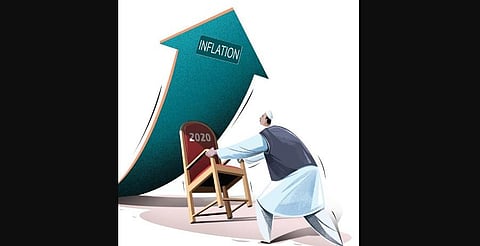

NEW DELHI: A Reserve Bank of India (RBI) working paper on inflation released on Monday said that the trend inflation just before the outbreak of Covid-19 was 4.1 -4.3 per cent and advised colloquially “if it ain’t broke, don’t fix it,” while advocating “maintaining the inflation target at 4 per cent into the medium-term.” The current inflation target of the central bank is 4 per cent, plus or minus 2 per cent. In case the inflation goes beyond this, the central bank usually uses a number of tools including holding or raising rates to check inflation.
The paper titled ‘Measuring trend inflation in India’ co-authored by Deputy Governor Michal Debabrata Patra and a researcher H K Behera, however, is significant as it comes in the backdrop of cries from various circles for lowering the central bank’s inflation target in order to allow bank lending rates to come down further. RBI’s repo or overnight lending rate which sets the trend for bank lending rates is already at a low of 4 per cent.
The RBI’s Monetary Policy committee (MPC) held the repo rate steady at its last meeting three weeks ago as it felt inflation was still too high. Since then there have been hints thrown from government circles that the inflation target should possibly be reworked in light of the needs to push up growth to tackle the Covid- induced economic downturn. Patra is part of the MPC, which in consultation with the government will be determining the new flexible inflation targeting or FIT which was set in 2016, at a meeting in March next year.
“A target that is fixed above-trend renders monetary policy too expansionary and prone to inflationary shocks and unanchored expectations. Hence, maintaining the inflation target at 4 per cent is appropriate for India,” the paper noted. It added that its model suggests a steady decline in trend inflation since 2014 to 4.1-4.3 per cent just before COVID-19 struck. The underlying decline in trend inflation is a fall in persistence of inflation, indicating that households and businesses are becoming more forward-looking than before as credibility associated with monetary policy increases.
Rural-urban inflation
Rural-urban inflation reveals close co-movement, with episodic divergences driven by components like food and fuel which does not persist in long run, says RBI paper.
