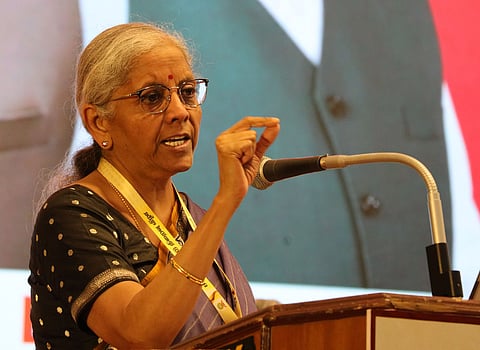

India is in a position to absorb shocks arising due to the current global trade uncertainties, geopolitical challenges and tariff situations, said Finance Minister Nirmala Sitharaman during her address at the Kautilya Economic Conclave 2025 in New Delhi.
"Sanctions, tariffs, and decoupling strategies are reshaping global supply chains. Wars and strategic rivalries are redrawing the boundaries of cooperation and conflict. Alliances that once appeared solid are being tested, and new coalitions are emerging. For India, these dynamics highlight both vulnerability and resilience. Our capacity to absorb shocks is strong, while our economic leverage is evolving," said Sitharaman at the event.
She acknowledged that for many smaller developing nations, the current geopolitical environment poses fundamental challenges. Developing economies face several risks, but also opportunities, she added.
Sitharaman highlighted the resilience of the Indian economy and called for inclusive global cooperation. She acknowledged downside risks—from tariff escalations in developed markets to slowing demand in key export destinations—but noted that India’s reliance on domestic demand, infrastructure investment and policy flexibility has been a buffer.
At the same time, Sitharaman called for reforms in multilateral institutions to better reflect the stakes of emerging economies—urging richer nations to provide climate finance, concessional lending and market access to developing countries. Her remarks echo India’s long-standing push for a greater voice for the Global South.
She added, "If multipolarity is our future, what shape will it take? Will it be one of cooperative pluralism, where different models coexist, or will it harden into rival blocs and spheres of influence, forcing nations to pick sides? History offers no guarantees, but the possibility of a fragmented world, with multiple centres of power, and competing values appears more likely."
She cautioned that trade imbalances have hollowed out industries in some nations while creating overcapacity in others. Financial imbalances have concentrated wealth in speculative sectors while depriving the real economy of investment. She asserted that the voices of developing nations can no longer be marginalised in rule-making and need to be amplified in shaping the future.
“We must be active participants, shaping outcomes where possible and preserving autonomy where necessary,” added Sitharaman.
India an anchor of stability amid global unrest: RBI Governor
In his address at the same event, Reserve Bank of India (RBI) Governor Sanjay Malhotra highlighted that India has emerged as an anchor of stability in a volatile world. Despite headwinds from trade tensions, elevated debt levels, and geopolitical volatility, India has maintained its resilience, he said.
"It is the combined efforts of the government's policy makers, regulators, and regulated entities. All in all, despite recent odds, the economy seems well settled into an equilibrium of resilient growth. This is quite a feat that makes India stand out as an anchor of stability in a volatile world," said the RBI Governor.
Malhotra asserted that despite global challenges, the country has been expanding foreign exchange reserves, and managed to have low inflation and a narrowing current account deficit as key pillars of strength. He outlined India’s monetary-fiscal coordination: aggressive liquidity support during the COVID crisis, a calibrated exit strategy, and revenue reforms to prevent food-price inflation from spilling into core metrics.
“Despite all odds, the economy seems well settled into an equilibrium of resilient growth,” added the RBI Governor.