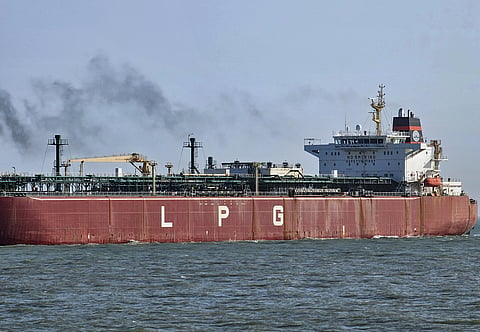

Jag Vikram, an India-flagged liquefied petroleum gas (LPG) tanker has succesfully crossed the Strait of Hormuz.
This marks the first transit by an Indian vessel since a temporary two-week ceasefire between the United States and Iran was announced.
Ship tracking data showed the tanker moved through the strategic waterway between Friday night and Saturday morning and was located in the Gulf of Oman, east of the Strait on Saturday afternoon, proceeding eastwards.
The vessel movement was also confirmed by a government statement giving an update on developments in West Asia.
"The India-flagged LPG vessel Jag Vikram has safely crossed the Strait of Hormuz today (Saturday)," it said.
"The vessel is carrying approximately 20,400 tonnes of LPG cargo with 24 seafarers onboard. It is expected to arrive at Mumbai on April 15, 2026."
Jag Vikram is the ninth Indian vessel to exit the Persian Gulf since early March, while about 15 India-flagged ships remain in the region, awaiting passage.
Owned by Mumbai-based Great Eastern Shipping Company, Jag Vikram is a mid-sized gas carrier with a deadweight capacity of over 26,000 tonnes.
At least 28 India-flagged vessels were in the Strait of Hormuz region when the West Asia conflict erupted, including 24 on the western side and four on the eastern side of the waterway.
Prior to Jag Vikram's transit, eight vessels from the western side and two from the eastern side had managed to sail to safety.
Several foreign-flagged ships carrying India-bound cargo also remain stranded in the Persian Gulf.
According to MarineTraffic data, hundreds of vessels remain in the region, including 426 tankers, 34 LPG carriers and 19 LNG vessels, many of which had been effectively stranded amid the disruption.
The government statement said that port operations across India remain normal, with no congestion reported.
"The Ministry of Ports, Shipping and Waterways continues to coordinate with the Ministry of External Affairs, Indian Missions, and maritime stakeholders to ensure seafarer welfare and uninterrupted maritime operations," it added.
India, the world's third-largest energy consumer and fourth-largest gas user, imports about 88 per cent of its crude oil, around half of its natural gas needs and nearly 60 per cent of its liquefied petroleum gas (LPG) requirement, underscoring its dependence on overseas supplies.
More than half of crude imports, about 40 per cent of gas and up to 85-90 per cent of LPG shipments come from Gulf countries and pass through the Strait of Hormuz, a key global energy corridor that was shut during the West Asia conflict.
The United States and Iran earlier this week agreed to a conditional two-week ceasefire that includes reopening the Strait for shipping.
India curtailed LPG supplies to commercial users such as hotels and restaurants after disruptions to Gulf energy flows, before restoring about 70 per cent of pre-crisis volumes as alternative supplies were secured.
Natural gas supplies were initially cut to industries, including fertiliser plants, to prioritise CNG for transport and piped cooking gas for households.
Supplies to fertiliser units have since been partially restored, with operating urea plants receiving about 80 per cent of recent average consumption, while overall allocation to the sector has been raised to around 95 per cent this week.
Gas availability to other industrial and commercial users has also been increased gradually, though it remains below normal levels.
City gas distributors have been directed to prioritise piped natural gas connections for commercial establishments, including hotels, restaurants and canteens, as part of efforts to shift demand away from LPG.
(With inputs from PTI)
