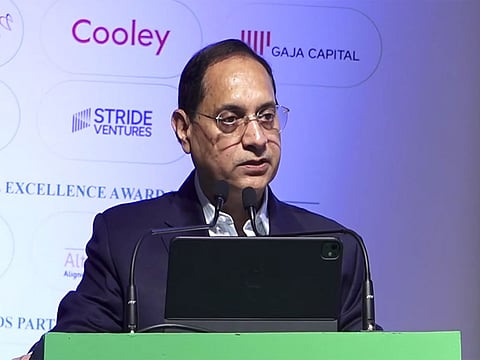

India is increasingly being recognised as a stable global capital hub, with its market capitalisation at about US$4.4 trillion and around US$154 billion raised through equity and debt markets in FY26, according to Securities and Exchange Board of India (SEBI) Chairman Tuhin Kanta Pandey.
Speaking at a high-level interaction organised by the Confederation of Indian Industry (CII) and the US-India Business Council (USIBC) on the sidelines of the IMF-World Bank Spring Meetings, Pandey highlighted the resilience of Indian markets despite global volatility.
The interaction brought together global investors and financial institutions to discuss the evolving structure of India’s capital markets. Pandey said India’s market capitalisation currently stands at around USD 4.4 trillion. In 2025, the country ranked first globally in IPO volumes and third in capital raised. More than US$154 billion has been raised through equity and debt markets in FY26. Mutual fund assets under management are nearing USD 900 billion, while commitments to Alternative Investment Funds (AIFs) have crossed USD 175 billion.
He said India’s financial system is playing a growing role in driving economic growth, backed by a projected GDP growth of 7.6 percent for the current fiscal year. He also pointed to the depth of the markets, noting India’s top global ranking in IPO volumes and its third position in capital raised in 2025.
Pandey said India’s capital markets have become a key pillar of the financial system, with the ability to raise funds at a global scale. He added that GDP growth for FY26 was expected to be 7.6 percent.
The discussion noted that India is now seen not just as an emerging market, but as a standalone investment destination. This shift is supported by strong institutions and a diverse mix of sectors, including technology, healthcare and energy. Foreign Portfolio Investor (FPI) assets are close to US$780 billion, making up about 17 per cent of listed equity. The corporate bond market is also nearing US$650 billion, providing important funding for infrastructure.
Pandey said the regulatory approach aims to balance investor protection, market growth and integrity. Key reforms include the introduction of T+1 settlement, faster IPO timelines, net settlement for FPIs, easier access for global investors, and stronger governance norms for market institutions.
Looking ahead, he said SEBI is working to make it easier for foreign investors to participate. This includes reviewing rules to simplify registration and aligning Know Your Customer (KYC) requirements across regulators.
Plans are also in place to launch a dedicated digital portal for foreign investors and to ease KYC norms for Non-Resident Indian (NRI) investors, to support private capital and derivatives markets.
Participants said India continues to be a reliable destination for global capital. While issues such as secondary market liquidity and taxation still need attention, the growth of alternative investment funds is helping channel risk capital into emerging sectors such as deep tech and climate technologies.
(With inputs from ANI)
