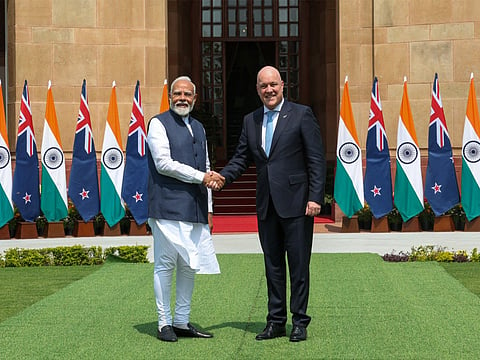

India and New Zealand are set to sign a long-awaited free trade agreement (FTA) on Monday, marking a significant step toward deepening economic ties and expanding bilateral trade in goods, services, and investments. The pact will come into force on a mutually agreed date.
What is the FTA about?
A free trade agreement is an arrangement between two or more countries to eliminate or significantly reduce tariffs on most traded goods, while also easing regulatory barriers that affect trade and investment flows.
A long road to conclusion
Negotiations for the India–New Zealand FTA were first launched in 2010 but stalled in 2015 after nine rounds of talks. After nearly a decade-long pause, discussions resumed on March 16, 2025, culminating in the conclusion of talks on December 22, 2025. The agreement is now ready for signing on April 27, 2026.
The FTA spans 20 chapters, covering areas such as trade in goods and services, rules of origin, customs procedures, sanitary and phytosanitary measures (SPS), technical barriers to trade (TBT), dispute settlement, and legal frameworks.
Gains for India
The agreement offers Indian exporters duty-free access to New Zealand across all goods categories, including labour-intensive sectors such as textiles, leather, plastics, and engineering products. New Zealand’s relatively low average tariff of 2.3% will effectively drop to zero for Indian goods.
A key highlight is New Zealand’s commitment to facilitate $20 billion in foreign direct investment (FDI) into India over the next 15 years.
India has also secured access in several high-value services sectors, including IT and IT-enabled services, education, financial services, tourism, construction, and professional services.
In a boost to mobility, the pact introduces a new temporary employment visa pathway for Indian professionals. The scheme will allow up to 5,000 skilled workers at any given time to live and work in New Zealand for up to three years.
Additionally, Indian exports of wine and spirits will enjoy duty-free access, while New Zealand wines will enter India at concessional rates that will be gradually reduced over a decade.
Gains for New Zealand
India has offered market access on about 70% of tariff lines, with 54.11% of New Zealand exports gaining duty-free access from day one. This includes products such as sheep meat, wool, coal, and forestry goods, which are expected to become more affordable for Indian consumers.
Tariff concessions have also been extended to agricultural products such as apples, kiwifruit, manuka honey, and milk albumin, though these will be subject to quotas and minimum import prices to protect domestic producers.
Duties on seafood items like mussels and salmon will be phased out over seven years, while tariffs on select metals such as iron, steel, and aluminium scrap will be eliminated over a period of up to 10 years.
Imports of avocados and persimmons will also see tariffs reduced to zero over a decade.
Sensitive sectors protected
India has kept several sensitive sectors out of the agreement to safeguard farmers and small businesses. No tariff concessions have been offered on dairy products, most animal products, key vegetables and pulses, sugar, and edible oils.
The exclusion list also includes sectors such as copper, aluminium, gems and jewellery, and arms and ammunition.
Investment and strategic importance
The $20 billion investment commitment marks a major jump from current levels, with New Zealand’s cumulative FDI in India standing at just $89 million between April 2000 and December 2025.
Strategically, the agreement strengthens India’s presence in the Indo-Pacific by improving access to a high-income, rules-based market. For New Zealand, it provides a stable foothold in one of the world’s fastest-growing major economies amid global trade uncertainties.
The Indian diaspora in New Zealand, numbering over 300,000 people, is expected to play a key role in enhancing trade and investment ties. Easier visa norms and streamlined student pathways could further boost services trade.
Trade snapshot
Bilateral merchandise trade between the two countries stood at $1.3 billion in 2024–25, with India exporting $711.1 million worth of goods and importing $587.13 million.
Total trade in goods and services reached approximately $2.4 billion in 2024, with services trade alone accounting for $1.24 billion, driven by sectors such as travel, IT, and business services.
India’s key exports include aviation fuel, pharmaceuticals, motor vehicles, petroleum products, garments, and machinery. Imports from New Zealand primarily consist of wood products, iron and steel, raw wool, dairy goods, scrap metals, coal, and agricultural inputs.
(With inputs from PTI)
