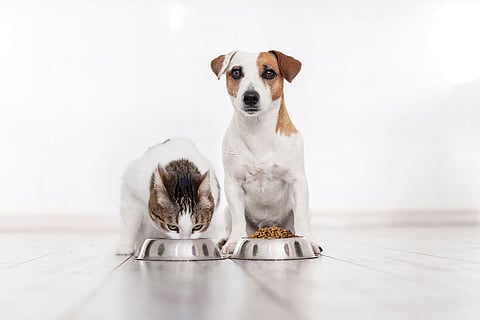

India’s pet care market is emerging as an increasingly attractive opportunity for consumer companies, with rising pet ownership, higher spending on nutrition and healthcare, premiumisation and the growing influence of e-commerce drawing established businesses and new-age brands into the sector.
The opportunity is being driven by a fundamental change in the way Indians view their pets. Pets are increasingly being treated as family members, prompting owners to spend more on food, grooming, healthcare and other products and services.
According to Euromonitor, India had around 40 million pet dogs and four million pet cats. The overall pet care market, measured by retail value or MRP, was estimated at Rs 6,300 crore in 2025 and grew about 13%. The market is expected to expand at more than 15% annually through 2030.
The relatively small size of the market compared with other large consumer categories is itself attracting companies that see significant headroom for penetration and premiumisation.
Food remains the largest component of pet spending, but the category is changing rapidly. Pet owners are increasingly looking beyond basic nutrition to products tailored to breed, age and specific health requirements.
Urbanisation, rising disposable incomes and changing consumer attitudes are driving demand for premium and health-oriented products, including wet cat food, specialised grooming products and orthopaedic accessories. The shift is also creating opportunities for companies that can establish science-backed credentials and offer specialised products.
Big consumer companies enter
The opportunity is attracting companies with established brands, distribution networks and consumer businesses. The Indian pet care market, dominated by US-based Mars, maker of Pedigree pet food, has seen several large consumer companies enter the segment over the past couple of years.
Mukesh Ambani-promoted Reliance Consumer Products, Nestlé India, Godrej Industries and Wipro Consumer Care are among those seeking a share of the growing market.
Nestlé expects pet food to be one of its faster-growing categories, although it has cautioned that the business remains relatively small and will take time to become significant in absolute terms.
Philipp Navratil, CEO of Nestlé SA, said the company expects pet adoption and pet food consumption to increase, creating a long-term opportunity. Nestlé also expects eventually to establish manufacturing capability for pet food in India, although it has not disclosed a timeline or investment amount.
For Nestlé India, the pet food business, part of its Prepared Dishes and Cooking Aids segment, reported high double-digit growth in FY26. The company attributed the performance to new product launches, wider distribution and greater engagement between pets and pet owners.
Wipro Consumer Care has also entered the segment with Snuggles, a nutritional pet food brand.
“As pet parenting continues to evolve, we see a significant opportunity to offer superior nutrition, trusted ingredients and meaningful innovation at a price point that delivers outstanding value to our customers,” said Anil Chugh, President, Foods Business and Chief Operating Officer, New Business, Wipro Consumer Care and Lighting-India.
Godrej is another major consumer company making an aggressive push into the sector. Godrej Pet Care has expanded its Ninja dog food brand from Tamil Nadu to Karnataka, Andhra Pradesh, Telangana and Kerala.
The company estimates India’s pet care market at around Rs 6,000 crore, of which pet food accounts for about Rs 5,000 crore. South India alone represents an estimated Rs 1,800-2,000 crore of the national pet food market, according to the company.
Nitin Jain, COO of Godrej Pet Care, said South India is a key growth market and that the company sees significant potential for long-term category development.
“Godrej Pet Care is democratising the pet food category by offering great quality product at an affordable price-point than those available in the market,” Jain said.
The company has committed Rs 500 crore to pet care over the next few years and is targeting rapid expansion in southern India.
Godrej is also positioning its products around science-led nutrition. Its Ninja range, developed and tested at the Nadir Godrej Centre for Animal Research & Development, contains probiotics, prebiotics, polyphenols and 37 nutrients aimed at digestive health and immunity.
Reliance Consumer Products launched its Waggies pet food brand in November 2025.
Competition widens
The entry of large consumer companies is coinciding with the expansion of established pet food players and new-age brands.
Euromonitor data show that Mars International India led the dog food category with a 36% retail value share in 2025, although its share declined from 38% in 2021.
Godrej Ninja and Wipro are among the newer entrants targeting consumers with accessible pricing and functional formulations such as probiotics and immunity-support products. Euromonitor expects such challengers to put pressure on mid-tier incumbents.
Venture capital-backed startups have also entered the market. Supertails, a pet care startup launched in 2021, raised Series C funding and entered quick commerce in 2026. Other players include Bengaluru-based Zigly, Smylo, which attracted investment following its appearance on Shark Tank India, and Taiyo.
Digital channels change the game
The growth opportunity is not limited to traditional supermarkets and pet stores. E-commerce, quick commerce and app-based subscription models are changing how pet owners buy products.
Euromonitor said the rapid rise of e-commerce and subscription-based models is reshaping purchasing habits by offering convenience and personalised experiences, particularly for urban professionals.
This is particularly important for new brands, which can build direct relationships with pet owners without having to immediately replicate the physical distribution networks of established consumer companies.
The growing digital footprint of players such as Mars, Drools, Farmina and Purpet is therefore adding another layer of competition to the market.
For companies entering the sector, the opportunity extends well beyond selling bags and cans of pet food.
As owners spend more on their pets, businesses are moving towards integrated models covering nutrition, veterinary care, grooming, accessories and wellness. The emergence of these ecosystems also explains why investors and companies are looking at the pet market as a long-term consumer opportunity rather than simply a niche food category.
At the same time, there remains substantial room for market expansion. India’s estimated 40 million dogs and four million cats represent a large potential customer base, while pet food penetration is still developing.
Alakshya Singh, who interned with The New Indian Express, also contributed to the story
