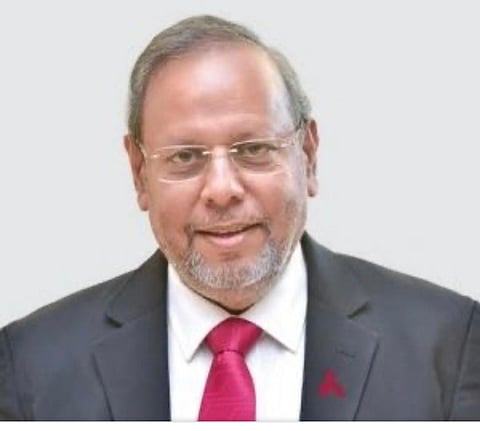

While India has managed to absorb the economic fallout from the West Asia conflict better than initially feared, the conflict has highlighted the need to strengthen strategic reserves and diversify critical supply chains beyond traditional sources, said Prof. S. Mahendra Dev, Chairman, Economic Advisory Council to the Prime Minister (EAC-PM). In an interaction with TNIE's Pushpita Dey, he shares the experience also reinforced the case for building domestic capacity in semiconductors, critical minerals and other strategic sectors. Edited excerpts:
What specific lessons has the West Asia conflict revealed about India’s strategic petroleum reserves? Should India be more aggressive in securing long-term energy partnerships outside the Gulf?
The conflict has shown India’s resilience in the face of global disruption and uncertainty in the oil market. Strategic petroleum reserves are part of broader energy supply-chain infrastructure, which includes above-ground storage tanks, pipeline systems, terminal tankages, offshore storage, refinery tankage, etc. Collectively, all of this storage infrastructure amounts to a national capacity to store crude oil and petroleum products large enough to meet 74 days of import requirements.
In addition to the already established strategic petroleum reserves at Visakhapatnam, Mangaluru and Padur, the government has also approved additional reserves in Odisha and Karnataka, and new sites for establishing SPRs are being continuously assessed.
At the same time, India has diversified its sources of crude oil to more than 40 countries, and this includes countries outside the Gulf region.
The kind of increase in prices seen at the retail level in other countries has been much higher. India has balanced consumer welfare and macro-prudence very well.
If the West Asia conflict marks the beginning of a more fragmented global order, what aspect of India’s economic model will need the most significant rethink?
Discussions around a more fragmented global order have been around for some time now. India’s emphasis on Atmanirbharta provides a sound basis for thinking about the current global situation. This does not mean a return to a protectionist economy, but an emphasis on competitiveness and more resilient supply chains.
India has concluded Free Trade Agreements (FTAs) with important partners recently. The FTA with the UK has already come into force, while the FTA with the EU has also been concluded.
To increase competitiveness, ease-of-doing-business reforms are being implemented, which include doing away with excessive compliances and redundant laws. Deregulation, both at the Centre and state level, is being taken up through respective high-level committees.
Public capex is being maintained and expanded, which has led to an improvement in the quality of public expenditure and has the potential to crowd in private investment.
At the same time, policy pushes in strategic areas such as semiconductors, critical minerals and R&D are being undertaken and yielding results. All of this provides a coherent framework for dealing with a more fragmented global order.
Many economists argue India missed opportunities during earlier supply-chain shifts away from China. What must India do differently over the next five years to avoid repeating that mistake?
India has done well in getting integrated into electronics supply chains. For instance, over the past decade, exports of electronics goods have increased eightfold, while exports of mobile phones have increased 127 times.
A crucial component of supply chains today is semiconductors. This is also important for positioning ourselves for the technologies of tomorrow.
Twelve semiconductor projects across six states have been approved, and three have started commercial production. Semicon 2.0 builds on this momentum for the development of India’s semiconductor design and manufacturing ecosystem.
This is significant both from a self-reliance point of view and in terms of securing supply chains. Since an enabling environment has been created for manufacturing, various players are likely to leverage FTAs and become an increasingly important part of global supply chains.
You have called for mapping vulnerabilities in energy, food, fertilisers, metals and critical minerals. Which of these areas currently presents the greatest strategic risk to India? Has the government identified any critical supply-chain chokepoints that surprised policymakers during this conflict?
All these aspects cannot be viewed in isolation; therefore, government policy is holistic and follows a whole-of-government approach. The conflict has brought attention to chokepoints related to shipping lanes and mineral processing, and the government has ably managed the challenges by drawing on a diverse range of import sources.
With the tension still not eased between the US and Iran, what could be the further economic repercussions, and how should India be prepared to absorb that? Should we prepare for slower economic growth this year?
Growth is likely to be around 7%. This figure is close to what the RBI is projecting at 6.7%.
One of the remarkable observations during this crisis has been that the elasticity of demand with respect to oil has turned out to be much higher than anticipated, and predictions about oil prices rising to extremely high levels have not turned out to be true.
Of course, this does not mean that we should be complacent, and there is a need to be vigilant. But the economy is placed much better than what many were projecting.
