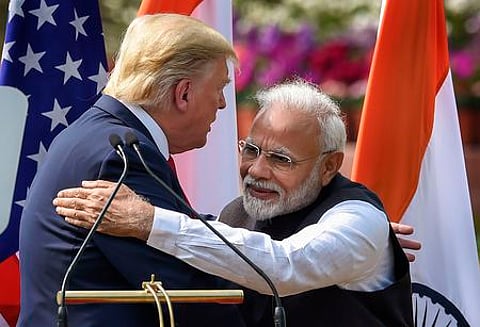

The announcement by US President Donald Trump reducing tariffs on Indian exports to 18% from punitive levels as high as 50% has triggered optimism across India’s export ecosystem, with industry bodies calling it a lifeline for labour-intensive sectors that had lost competitiveness in the American market.
Sectors such as textiles, apparel, leather, carpets and footwear — among the worst hit by the steep US duties — expect a revival of stalled orders and restoration of production cycles that had slowed sharply over the past few months. With just 18% tariff, India now has an edge over countries like Bangladesh and Vietnam (at 20% tariff) and Malaysia and Indonesia (at 19% tariff).
“This reduction in tariff will ensure our textile and apparel exporters are once again in a position to compete effectively in the US market, the single-largest market for India's textile and apparel exports. This deal will also ensure that factories can run at full steam once more and job creation can get back to previous levels,” said Ashwin Chandran, Chairman, Confederation of Indian Textile Industry (CITI).
Industry executives say the high tariff regime had virtually priced Indian products out of the US market, allowing competitors from other Asian nations to corner orders. With tariffs now pegged at 18%, exporters expect a significant release of deferred orders, especially as US buyers typically finalise sourcing for the summer season by December.
“The reduction in reciprocal tariffs—from earlier levels of around 50% to 18%—would materially strengthen the competitiveness of Indian exports vis-à-vis other Asian suppliers. This is likely to lead to a meaningful release of orders that were temporarily deferred, particularly in labour-intensive sectors such as apparel, textiles, leather and footwear,” said Ajay Sahai, Director General and CEO, Federation of Indian Export Organisations (FIEO).
Kumar Mangalam Birla, Chairman of the Aditya Birla Group, said the development could deepen economic engagement and investment flows between the two countries.
“The reduced tariffs will help strengthen the strategic and economic ties between our two great countries and provide additional opportunity for investment and collaboration. The Aditya Birla Group is the largest Indian investor in the US, and we see this agreement help shape more resilient supply chains, unlock manufacturing opportunities and drive long-term economic competitiveness in both the US and India,” Birla said.
Commerce and Industry Minister Piyush Goyal described the development as a “landmark trade agreement” reflecting the strength of ties between the two democracies.
“This agreement unlocks unprecedented opportunities for farmers, MSMEs, entrepreneurs and skilled workers to Make in India for the world, Design in India for the world, and Innovate in India for the world. It is not just a trade deal — it is a historic turning point that will reshape India–US relations and accelerate our journey towards Viksit Bharat 2047,” he said.
Goyal added that the agreement would facilitate greater technology access from the US and deepen cooperation across sectors.
But experts warn: political signal, not final deal yet
However, trade policy experts and think tanks have urged restraint, pointing out that critical details of the arrangement remain unclear.
India should not rush to celebrate President Trump’s trade announcement. The Truth Social post leaves major questions unanswered—what products are covered, what the timelines are, and whether India has really agreed to zero tariffs and zero non-tariff barriers, especially in sensitive areas like agriculture and regulated imports. The headline figure of $500 billion in U.S. purchases is also unclear. India currently imports less than $50 billion a year from the U.S., suggesting this is more an aspiration than a firm commitment.
Until there is a joint statement, negotiated text, and clarity on enforcement, this should be seen as a political signal—not a final deal. Caution, not celebration, is needed.
