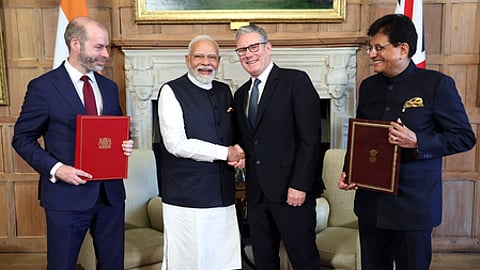

The comprehensive economic and trade agreement (CETA) that was signed between India and the UK on July 25, 2025, after several rounds of negotiations, will come into force from July 15, 2026.
This will be the sixth free trade agreement to be implemented by the Narendra Modi government. Earlier, India implemented such pacts with Mauritius, UAE, Australia, EFTA (European Free Trade Association), and Oman.
The agreement, one of the biggest for New Delhi in the past few years, will unlock duty-free access for nearly 99% of Indian exports.
Below are some of the key points to understand the significance of CETA for Indian businesses and consumers:
Advantage India
All labour-intensive sectors such as garments, textiles, footwear, carpets, processed food, cereals, vegetables, fruits and spices, fish, meat and processed products will now enter in the UK market with zero duty. At present, the duty on these goods ranges between 4 to 16 per cent.
The other sectors that will gain from the pact include automobiles, motorcycles and parts; machinery, electronics and fabricated metal products; and ceramics, glass, stone and cement products
Duty reduction on British goods such as salmon, lamb, machinery, electronics, chocolates, soft drinks, cosmetics, cosmetics-like soaps, perfumes, shaving creams, and nail polish may lead to cut in prices in the Indian market.
India will cut tariff on silver, the largest import item from the UK to zero in 10 years.
Auto sector
For the first time in an FTA, India has agreed to sharply reduce import duties on UK-made fully-built cars and trucks. Tariffs will come down from 110 pc to 10 pc in a phased manner.
Petrol and diesel vehicles will get concessions from the start, while electric, hybrid and hydrogen passenger cars will gain preferential access only from the sixth year, giving Indian EV makers five years of protection.
India will allow the import of 3.78 lakh units of conventional-engine passenger cars, including those in the mass segment, from the UK at concessional customs duty during the first 15 years of the implementation of the trade pact between the two countries.
India will also cut tariffs on UK-made trucks imported as fully-built units. The current 44% duty will come down to 8.8% within the quota by Year 5. The quota will rise from 2,500 trucks in Year 1 to 3,500 from Year 5. Trucks imported outside the quota also benefit, with the tariff gradually falling to 22% by Year 10.
The UK has granted concessions for Indian electric, hybrid and hydrogen passenger cars. The UK's normal tariff on passenger cars is 10%. Under CETA, eligible Indian vehicles exported within an annual quota will enter duty-free, giving them a 10-percentage-point advantage.
Alcohol
The deal lowers tariffs across a wide range of premium drinks, including cider, mead, sake, brandy, bourbon, rum, gin, vodka, liqueurs and tequila.
For qualifying products, the standard 150% duty will fall to 110% in Year 1 and then to 75% by Year 10. The concession will apply only above a minimum import price (MIP), generally $5 a litre, equivalent to $3.75 for a 750 ml bottle, or $6 per 750 ml bottle, depending on the product.
On Scotch whisky, India's tariff will fall from 150% to 75% initially and then to 40% by year ten.
No concessions
India will not give any duty concessions on products like fresh apples, walnuts, whey and modified whey, blue-veined cheese, and specific seed categories, gold bars, and smartphones.
The UK's exclusion list includes various meat products, egg-based items, semi-milled or fully milled rice, and solid-form cane or beet sugar.
Government procurement
India has granted market access to UK suppliers in government procurement. For the first time, India will open about 40,000 high-value contracts from central ministries and departments in sectors such as transport, green energy, and infrastructure to bidders from the UK.
UK suppliers receive treaty-backed access to covered central government procurement in India, and firms meeting a 20 pc UK-content threshold may qualify as Class 2 Local Suppliers.
Intellectual property rights
According to think tank GTRI, India resisted patent-term extensions and pharmaceutical data exclusivity but accepted stronger IP enforcement obligations and recognised voluntary licensing as the preferred approach.
The pact, however, does not restrict India's use of compulsory licensing (CL) in any form. CL is a critical tool to access life-saving technologies during emergencies.
Indian companies operating in the UK would not have to make social security contributions for up to five years for employees they move from India to support their operations, a move which will give a major boost to IT majors like Tata Consultancy Services (TCS) and Infosys.
Rules of Origin
Rules of Origin determine a product's economic nationality, whether it is Indian, British or from a third country.
They are essential because CETA's lower tariffs are meant only for goods from India and the UK. Without such rules, a Chinese or other third-country product could be routed through either country after minor processing to claim FTA benefits. The rules therefore, set the minimum production, processing or value addition needed to qualify.
Steel safeguard
GTRI has stated that India exported about USD 900 million of steel and steel products to the UK in FY2026, nearly 7% of its total $13.4 billion goods exports, but this trade could come under pressure as Britain tightens its steel import regime from July 1, 2026.
Bilateral trade and investment
Trade with the UK grew by 8.62 pc to USD 25.12 billion in 2025-26 from USD 23.13 billion in 2024-25. India's exports dipped 7.6 per cent to USD 13.44 billion last fiscal. Imports were up by 36.11 per cent to USD 11.68 billion in 2025-26.
In 2025-26, India received FDI worth USD one billion. It was USD 795 million in 2024-25.
