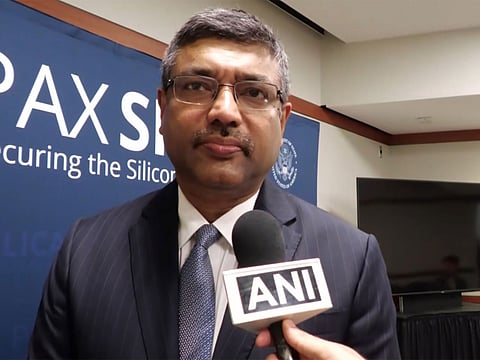

The government on Wednesday approved an outlay of Rs1.27 lakh crore for the second phase of the Semicon India Programme (Semicon India 2.0) to strengthen the country's semiconductor ecosystem. Semicon India 2.0 aims to develop the entire semiconductor value chain. The Cabinet also approved the Mobile Phone Manufacturing Scheme (MPMS) with an outlay of Rs62,500 crore to boost domestic value addition, increase exports and encourage the manufacturing of key smartphone components in India. The TNIE spoke to Ministry of Electronics and Information Technology (MeitY) Secretary S Krishnan about Semicon India 2.0, the MPMS and India's semiconductor ambitions. Edited excerpts:
How is Semicon India 2.0 different from Semicon India 1.0?
Semicon India 2.0 takes a much broader ecosystem approach. In addition to supporting semiconductor fabs and ATMP/OSAT facilities, the scheme will also incentivise companies manufacturing semiconductor equipment, materials, gases, chemicals, testing facilities and other critical components of the supply chain.
On the design side, we are strengthening the Design Linked Incentive (DLI) scheme. The scheme will also expand eligibility beyond startups and MSMEs to include large companies. The detailed guidelines will be issued shortly.
Do you expect global chipmakers such as Intel, TSMC or Samsung to invest in India under Semicon India 2.0? Are discussions underway?
Our effort is to attract some of the world's leading semiconductor companies. At the same time, we want Indian companies to enter into technology partnerships and joint ventures with global players.
Does India have enough skilled talent for the upcoming semiconductor projects?
Skilling is a continuous process, and we expect to train an adequate workforce. However, some dependence on foreign expertise in the initial years is inevitable.
Most semiconductor investments under Semicon India 1.0 were announced in Gujarat. Will Semicon India 2.0 encourage projects in other states?
I don't think that is an accurate characterisation. Globally, semiconductor industries tend to develop in clusters because clustering offers significant advantages. While Gujarat is one cluster, there are also clusters around Noida, as well as emerging clusters in Assam and Odisha. The ecosystem is fairly well distributed.
The government wants to promote Indian mobile phone brands through the Mobile Phone Manufacturing Scheme (MPMS). How will that work?
It is not correct to say India has no domestic mobile manufacturers. Around 6% of the Indian mobile phone market is currently served by Indian brands, although their market share had once reached around 40-45%.
The objective is to revive Indian brands so that a larger share of value creation remains within the country.
