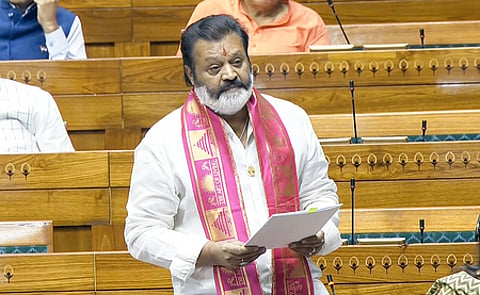

State-owned oil marketing companies (OMCs) have procured 2,417.78 crore litres of ethanol worth Rs1.72 lakh crore over the last three Ethanol Supply Years, said the minister of State for Petroleum and Natural Gas Suresh Gopi.
Replying to a written question in Rajya Sabha, the minister said ethanol procurement by Indian Oil Corporation (IOCL), Bharat Petroleum Corporation Ltd (BPCL) and Hindustan Petroleum Corporation Ltd (HPCL) increased from 679.04 crore litres in the 2023-24 Ethanol Supply Year to 1,033.31 crore litres in 2024-25. During the current Ethanol Supply Year (2025-26), the three OMCs have already procured 705.43 crore litres of ethanol up to June. The minister added that 501 ethanol suppliers are currently registered with the three PSU OMCs.
The minister also said the government has not taken any decision to increase ethanol blending in petrol beyond the current 20% level. Any future decision on higher ethanol blends, he said, will be taken only after detailed scientific and technical studies and consultations with stakeholders.
Rejecting the suggestion that E20 is a newly introduced fuel, Gopi said ethanol has been used as a transport fuel globally for over a century, while India's Ethanol Blended Petrol (EBP) Programme began with a pilot project in 2001.
He said the transition to E20 has been gradual, with the average ethanol blending rate increasing from 1.53% in 2013-14 to 20% during the 2025-26 Ethanol Supply Year (November-June) following scientific evaluation and stakeholder consultations at every stage.
According to the minister, before every increase in blending levels, studies were carried out in consultation with NITI Aayog, the Automotive Research Association of India (ARAI), the Society of Indian Automobile Manufacturers (SIAM), the Indian Institute of Petroleum (IIP), oil marketing companies and automobile manufacturers. These included laboratory testing, durability trials and field validation covering engine durability, material compatibility, corrosion resistance, drivability, emissions, fuel efficiency and overall vehicle performance.
Gopi said E20-compatible vehicles are certified only after undergoing the prescribed homologation process, while the impact on existing vehicles was also assessed before nationwide implementation.
He added that the government's findings have been reinforced through real-world experience. E15-plus fuel has been in widespread use for over three-and-a-half years and E19-E20 fuel for more than two-and-a-half years. More than 20 crore two-wheelers and over 3 crore petrol cars, including vehicles manufactured before E20 certification, have been operating on these fuels without any verified evidence of widespread engine failure or vehicle breakdown attributable to ethanol blending, he said.
