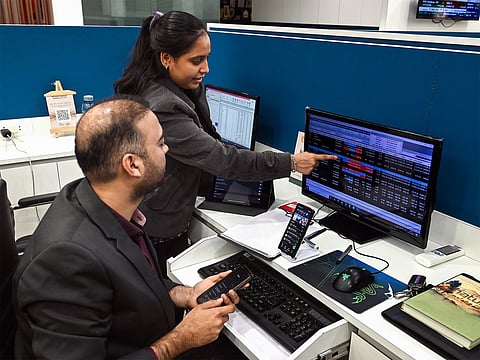

Indian equities ended lower on Friday (July 24) as weakness in auto stocks pushed the Sensex down 331.62 points and the Nifty lower by 102.15 points. The decline, however, was cushioned by gains in IT and banking stocks and broad-based buying across the market.
The Nifty opened with a sharp gap-down and remained under pressure in early trade before recovering part of its losses as easing crude oil prices and selective strength in banking and IT stocks provided support. However, the rebound proved insufficient to offset the broader weakness, with persistent domestic concerns and mixed global cues keeping the benchmark indices in negative territory.
"Indian equity markets extended their losing streak to a fifth consecutive session as investors remained cautious amid lingering geopolitical tensions in the Middle East and renewed concerns over US trade tariffs," said R Ponmudi, CEO, Enrich Money, an online trading and wealth tech company.
He added that weakness across Asian markets reinforced the risk-off mood, prompting broad-based selling despite signs of easing pressure in energy markets.
Asian stock markets also came under sharp selling pressure on Friday as investors reacted to US President Donald Trump's announcement of a fresh round of sweeping trade tariffs.
Major Asian indices ended on a mixed note as some investors balanced upbeat corporate earnings against persistent uncertainty over global trade and the outlook for interest rates.
Trump unveiled tariffs ranging from 10% to 12.5% on imports from dozens of countries, including the United Kingdom, Mexico, Canada, Australia, India, China, and the 27-member European Union. The move replaces the blanket 10% tariff imposed in February after the US Supreme Court ruled that many of his earlier tariffs were unlawful.
The announcement triggered a broad-based sell-off across Asian equities. Japan's Nikkei 225 plunged 3.1%, South Korea's Kospi tumbled 6.2% amid heavy losses in semiconductor stocks, China's Shanghai Composite fell 1.4%, and Hong Kong's Hang Seng index dropped 11.4%, reflecting heightened concerns over the impact of escalating trade tensions on regional growth and global supply chains.
The new US tariffs are expected to be imposed under Section 301 of the US Trade Act of 1974, which authorises action against countries deemed to engage in unfair trade practices. Following the Supreme Court's February ruling, Trump had said his administration would launch fresh investigations into trading partners to pave the way for permanent tariff measures.
On the global front, the conflict between the US and Iran continued to escalate, leaving the Middle East as the dominant source of market uncertainty. At the same time, fresh announcements on US tariffs added to investor caution.
Energy markets retreated from recent highs, snapping a multi-session rally. However, shipping activity through the Strait of Hormuz remains constrained following the escalating conflict between the U.S. and Iran, keeping supply risks firmly in focus. International crude oil prices fell more than 3.5% to trade near $89 a barrel, while domestic crude futures declined over 4.5% to around Rs 8,600. Despite the pullback, energy prices remain elevated, leaving India's import bill, inflation outlook and external balances vulnerable to any renewed escalation in geopolitical tensions.
In the currency market, the Indian rupee remained under pressure after weakening to a fresh two-month low of around Rs 96.67 against the US dollar before recovering modestly to trade near Rs 96.5.
Elevated crude oil prices, persistent geopolitical uncertainty and firm demand for the US dollar continued to weigh on the domestic currency, underscoring the macroeconomic headwinds facing India, say a couple of analyst reports reviewed by TNIE.com.
