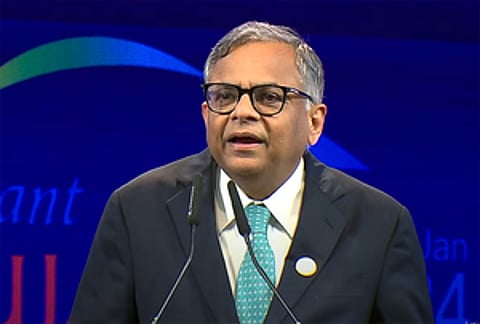

Rebuilding Air India is a long journey, and the airline’s transformation must be seen as a five- to ten-year journey, said Tata Sons N Chandrasekaran while reiterating the Tata group's commitment to rebuilding Air India into a world-class airline. The reassurance to support Air India comes as the airline reported its highest-ever annual loss in FY26.
“A nation of 1.4 billion people, with one of the world’s fastest-growing economies, deserves a world-class flag carrier. Rebuilding Air India is a long journey: fleet renewal, training, service transformation, and network expansion. Every great airline in history was built over decades, not quarters,” said Chandrasekaran in his address to shareholders in the Tata Sons FY25-26 annual report.
The Air India group reported a net loss of Rs 22,238 crore in FY26, double the Rs 10,859 crore loss a year earlier. The airline's revenue also declined to Rs 71,870 crore in FY26 from Rs 78,636 crore in FY25. Meanwhile, Tata Group's revenue at the aggregate level grew by 7.8% to Rs 16,24,030 crore in FY26, while profit after tax grew 51.9% to Rs 1,70,525 crore.
Revenue for Tata Sons, the primary investment holding company and promoter of the Tata Group, grew by 9.1% to Rs 42,367 crore in FY26, while PAT grew 21.8% to Rs 31,961 crore. The board of Tata Sons has recommended a final dividend of Rs 110,717 per share, subject to shareholders' approval.
Chandrasekaran said that this year (FY26), Air India faced three external headwinds - airspace closures, West Asia conflict-driven fuel price hikes and foreign exchange fluctuations; and the crash of AI171 made it the most challenging year for Air India. “Few businesses are as vulnerable to war and fuel pressures as aviation,” added the chairman.
He stated that given where it began, Air India’s transformation must be seen as a five- to ten-year journey, considering the years-long supply chain disruptions in key components, the need to overhaul legacy systems, culture and fleet, and the creation of a large cadre of technical and airline professionals.
After Air India, Tata Digital was the biggest loss-making entity for the group, with losses widening to Rs 4,974 crore in FY26 from Rs 4,610 crore in FY25. Among other unlisted companies, Agratas (Rs 1,101 crore), Tata Electronics (1,611 crore), Tata Play (Rs 552 crore), Tata Project (Rs 891 crore), and Tata Realty and Infrastructure (Rs 456 crore) reported losses in FY26. In the listed pack, Tata Chemicals reported a net loss of Rs 1,715 crore and Tejas Network reported a loss of Rs 909 crore last fiscal.
Tata Sons will hold its annual general meeting (AGM) on August 18, with the upcoming meeting expected to discuss the reappointment of chairman N Chandrasekaran as a director, among other topics. Chandrasekaran’s second term as the Tata Sons chairman ends in February 202
