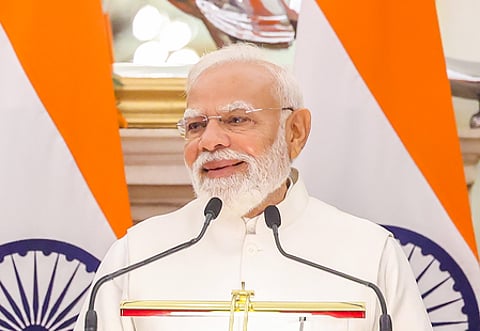

Since Narendra Modi became Prime Minister for the first time in 2014, the Indian equity market benchmarks have delivered returns of around 200% each, with the BSE Sensex gaining 200% and NSE Nifty50 surging 215% over approximately 12 years. A day before Modi took oath after the NDA coalition defeated the UPA coalition, the Sensex had closed at 24,693 and the Nifty settled at 7,367 on May 23, 2014.
In June 2026, the Sensex has climbed to nearly 74,000 level while Nifty50 is trading around 23,200. Owing to a stronger rally in midcap and smallcap pockets, the market capitalisation of BSE-listed companies grew from Rs 85 lakh crore to Rs 455 lakh crore over the last 12 years.
However, in percentage terms, the market's performance during the Modi era trails the gains recorded under the UPA government led by then Prime Minister Manmohan Singh. Between 2004 and 2014, the Sensex rallied nearly 400%, soaring from 4,961 to 24,693, a significantly stronger percentage return than that seen during the Modi years.
The comparison comes as Modi on Wednesday became India’s longest continuously serving Prime Minister.
During Modi’s first tenure (May 26, 2014 to June 4, 2019), the Sensex surged from 24,122 to 38,811, delivering a 61% return. While this period marked the government’s initial reforms such as the Insolvency and Bankruptcy Code (IBC) and early discussions on GST, market returns were hampered by relatively tepid corporate earnings amid a consumption slowdown.
However, Modi’s second term as PM (June 5, 2019 to June 5, 2024) delivered much stronger returns. Despite the COVID-19 pandemic-induced crash in the first half of 2020, sentiments improved rapidly and India became a global haven for investors seeking growth. In the second term, the Sensex surged from 38,811.39 to 74,382.24 (up 91.65%) in the backdrop of full implementation of GST in 2017, corporate tax reductions and increased share of retail investors.
The third term, however, has been a tale of two ends. When Modi’s third term began in June 2024 with a weaker majority, the market continued its upward journey and Sensex hit a high of nearly 86,000 in September 2024. However, since then the market has lost momentum and global investors, who not so long ago were bullish on India, have sold local equities on an unprecedented scale.
After severely underperforming in 2025 by delivering a return of just 9%, the Sensex has declined by more than 13% year to date in 2026. This period of sluggishness is marked by US tariffs on Indian goods, the West Asia crisis and FII preference for AI trade where India is seen as a major laggard.
In the broader market, the Nifty Midcap 100 index emerged as the standout performer, delivering returns of nearly 480% over the past 12 years. Among sectors, metals, auto and financial services were the biggest wealth creators, with their respective indices rising by around or more than 300% during the period.
