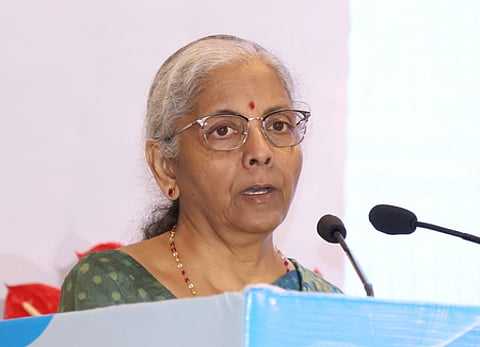

Finance minister Nirmala Sitharaman on Monday said that attracting more foreign capital is the need of the hour and accordingly the government is taking a calibrated approach.
She highlighted the recent measures by the Reserve Bank of India (RBI) will enable government banks to raise funds from overseas markets with reduced exposure to currency risks. She also indicated that the government will take more steps if needed to have for capital inflow.
Speaking at the MindmineSummit 2026, Sitharaman said, “We recognise we need more foreign capital to come, but the fact that that the RBI has now allowed public sector, undertaking banks to go out and pick money from outside, giving them a framework, and in that framework, the very important aspect is that the hedging is at the RBI's expense.”
To ensure more foreign capital inflows into the country, the RBI introduced a forex swap facility for public sector enterprises to raise external commercial borrowings (ECBs). Additionally, it also introduced swap facility for Foreign Currency Non-Resident (Bank), or FCNR(B), deposits with maturities of three-five years until September 30. The central bank plans to absorb the full hedging cost for banks on 3-5 years deposits and will also exempt fresh deposits from reserve requirements, so that the banks can offer higher yields without currency risk for NRIs.
The finance minister said the move is part of a broader strategy to ensure that domestic markets receive adequate investment while maintaining financial stability. “We have taken a very calibrated approach to make sure that the markets do receive the required investments,” she said.
Meanwhile, Sitharaman flagged concerns over possible headwinds in the domestic consumption this year due to the impact of the El Niño, which is likely to adversely affect the agricultural income and productivity. Underscoring the risks arising due to the El Niño effect this year, the minister said “Because of the El Niño, I think we are preparing for not so good consumption,” emphasising that the stress on rural incomes remains a key concern.
Assuring that India does have a buffer of food stocks for a year, she added, “For farmers, it will have an impact because this year this income will be stressed up.” She further flagged that the shortage of fertilisers due to the current geopolitical situation has made the situation worse. She highlighted how several countries have withdrawn themselves from the fertilisers’ global supply chain making the availability even more skewed.”
