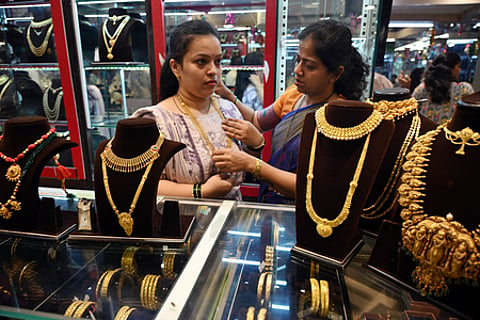

With crude completely easing the war-driven rally following the reopening of Hormuz and the resultant ebbing of inflation and rate hike worries, precious metals are set for a rally.
While gold is set for the steepest fall in a decade in the June quarter—from a record high of $5,600/ounce (28.35 grams) on January 29, 2026 to a low of $4,103 on June 27, losing 27%, its safe-haven pair silver has plunged much more—from $127/oz to $59.16 or losing 53.5% and making it the worst fall in four years. The reversal comes after a dream-run of the past two years: gold surged over 65% in 2025 and 28% in 2024, while silver climbed 28%, following a 148% surge in 2025 and 22% in 2024.
But both these metals are set to close Q1 in negative territory, breaking a five-quarter streak of gains, with gold on track for its steepest quarterly fall in a decade and silver headed for its worst showing in four years. The yellow metal has lost over 12% so far in the June quarter--steepest decline since December 2016, and silver is down close to 18%, its sharpest fall since June 2022.
Ironically, the period also saw a raging war on Iran, which upended global energy supplies sending prices of crude and everything originating from hydrocarbons over the roof. Why did these safe-haven assets missed the rally despite a crippling war in the world’s energy capital, while the Ukraine war, which was strategically much less impactful, sent the prices soaring? The massive correction still underway is also surprising as both these metals are known as a hedge against bleeding equities or rising inflation—both these events occurred since March—but pulled down these metals. Why?
Primarily because the dollar continued to gain despite the US badly losing the Iran war. In fact, according to many analysts, this was the most surprising factor in the Iran war. Fact is that despite the US making many self-goals on Iran war, the dollar index continued to rally almost every day and last week even crossed the 102-mark, hitting a 13-month peak after falling to a low of 95.55, as the a global technology stock sell-off led to a mounting safe-haven demand for the greenback, increasing expectation of Fed rate hikes. Global analysts are now seeing only a 60% chance of a US rate hike in September, down from 64% earlier.
But analysts still advice investors against exiting the precious metals as they still remain the best hedge against falling equities which since the Iran war have become captives of many an issue like lack of AI play or its overdose, inflation and the resultant interest rate hike fears. Because these metals still remain reliable investment options for portfolio diversification, wealth preservation, and hedging against inflation and currency depreciation, which in our case makes it the best pull-factor. But they also add that since these metals are non-income-generating assets, they shouldn't be your only investments and that a balanced approach is ideal.
Specifically speaking, while gold acts primarily as the best tool for long-term wealth preservation and safeguard against economic uncertainty or currency depreciation and thus tends to hold its value well during crises, silver has its advantage in its dual demand as both as a precious metal and as an industrial commodity with huge demand coming in from solar energy, electric vehicles, and electronics, retaining its potential to outperform gold during bull markets, which fortunately is on the anvil given that the war has ended. Coupled with this is the steady pick-up in Chinese demand along with the nearly contained inflation with a normalising oil supply and the resultant ebbing of rate hike fears.
