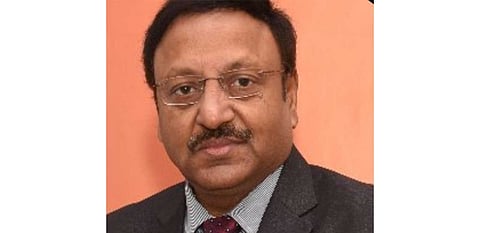

HDFC Bank has said its board has approved appointment of Rajiv Kumar, a former civil servant and a financial sector expert, to succeed Keki Mistry as its part-time chairman, subject to the approval of the Reserve Bank.
“The board at a meeting held on Monday approved the appointment of Rajiv Kumar as part-time chairman, subject to the approval of the Reserve Bank, for a three-year period,” the bank said in an exchange filing late Monday.
The board also recommended him as an independent director for a four-year tenure, effective June 30, the filing said, adding that this position will be subject to the approval of the shareholders at the forthcoming annual general meeting (32nd) scheduled for August 5.
On June 18, the RBI had permitted the bank to extend the tenure of Mistry, who was forced to take over the role after its previous part-time chair Atanu Chakraborty quit suddenly on March 18 making allegations alleging ethical and moral issues at the bank, for three more months or till it finds a new non-executive chairman. Following this surprise development and allegations, the bank appointed three law firms, including one from the US to probe the charges. Last week, the bank informed the exchanges that all the three law firms found no basis for Atanu’s allegations.
Mistry, an HDF veteran, took over the affairs of the bank for a three-month period and was categorical to state that he was not interested in a longer-term tenure at the bank where he was already a non-executive director.
Kumar is a former IAS officer with over four decades of experience in public policy, financial sector reforms and institution building.
Kumar had served as secretary in the Department of Financial Services during 2017-20, where he led banking sector reforms, including the recapitalisation and consolidation of public sector banks and played a key role in the merger of Vijaya Bank and Dena Bank with Bank of Baroda that preceded the large-scale consolidation of state-run banks. He also led reform initiatives in banking technology, digital payments, deposit protection and financial stability.
