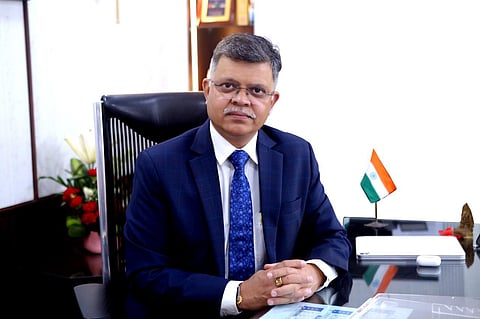

The Union Budget 2026-27 allocated a capital expenditure of ₹12.2 lakh crore for infra financing with roads, seven high-speed rail corridors, and urban development being the key focus areas. In an exclusive interaction with TNIE, Sanjay Kulshrestha, chairman and managing director (CMD) of the Housing and Urban Development Corporation Ltd. (HUDCO) talks about the challenges of infra financing and how can they be addressed. Edited excerpts:
Could you share your perspective on the overall budget highlights and specifically tell us how the new announcements align with the current growth trajectory of India’s urban infrastructure?
Over the past few years, the Government of India has placed infrastructure at the core, and this budget reinforces that focus by integrating higher reform-based capital spending along with policy clarity across Urban Infrastructure sectors.
The 10% rise in capex to over Rs12 lakh crore underscores the Government of India’s strong push for urban development. The extension of the Atal Mission for Rejuvenation and Urban Transformation (AMRUT 2.0) further reinforces the commitment to universal water supply, improved sewerage networks, and sustainable urban water management.
The Rs100 crore support to catalyse Rs1,000 crore in municipal bonds strengthens ULB creditworthiness and market access, enabling cities to improve service delivery and outcomes. Stronger ULB governance further shows that sound financial management and discipline are key to better infrastructure delivery and investment readiness.
With the World Bank estimating an annual need of Rs5–8 lakh crore for urban infrastructure until 2036, the budget begins bridging the gap through the Urban Challenge Fund, Urban Infrastructure Development Fund (UIDF), and Infrastructure Risk Guarantee Fund (IRGF).
Sustainability and private participation remain the two biggest hurdles in the urban story. How can we make 'green urbanization' financially viable, and why should private players believe that the new PPP ecosystem will be different from the challenges of the past?
Sustainability and private participation have long challenged India’s urban growth. For green urbanization to be viable, projects must reduce risk and improve bankability, an area where current policy makes a clear impact.
The Urban Challenge Fund aims to unlock nearly ₹4 lakh crore in projects, with the Government contributing Rs1 lakh crore and states 25%. This lowers the private sector’s capital burden, potentially requiring only about Rs50 for every ₹100 invested, improving viability and reducing upfront risk. Importantly, the framework addresses both asset and liability concerns that earlier slowed PPP projects, easing hesitation among developers and lenders.
In addition, a Partial Guarantee Fund protects lenders against uncontrollable risks, reducing uncertainty in long-gestation, climate-linked urban projects.
Combined with momentum from initiatives like Make in India and the Production Linked Incentive scheme, the ecosystem is becoming more supportive of private investment.
What is the most common challenge you face when you think of urban development in India that varies across the state?
One of the most common challenges in urban development across states is the variation in institutional and project preparation capacity. From a HUDCO and infrastructure financing perspective, the challenge is often not the availability of fund but project feasibility report and its assessment, and limited focus on bankability, viability & sustainability of the project. This leads to execution delays, cost overruns, and contractor payment issues.
Strongly governed entities with financial discipline manage projects more efficiently, while others face higher risks and slower implementation. Strengthening project structuring, appraisal, and financial management at the ULB level is therefore critical for sustainable urban development.
How can the gaps in project structuring, financing, and execution in urban infrastructure across states be addressed?
HUDCO addresses these gaps through its recent initiative, the Urban Invest Window (UiWIN),a dedicated window for providing 360-degree solution for Urban Infrastructure, is aligned with the objectives of the Urban Challenge Fund (UCF). At HUDCO, UiWIN operationalizes UCF’s focus on Cities as Growth Hubs, Creative Redevelopment of Cities, and Water & Sanitation by structuring bankable, revenue-backed projects and improving risk clarity to attract private
participation. Catalytic support under UCF reduces upfront risk and enhances viability.
For essential services like water, sanitation, and mobility, we promote ring-fenced revenues and stronger financial discipline to gradually improve ULB creditworthiness.
HUDCO is targeting a Rs3 trillion loan book by 2030. How do you plan to scale at this speed while balancing the high-risk nature of land reforms and the non-negotiable demand for environmental sustainability? What is your strategic formula for ensuring that this growth is both bankable and green?
As of this quarter, we are halfway to our 2030 goal, with a loan book of about ₹1.55 trillion and a sanctioned pipeline of nearly ₹3 trillion to be disbursed over the next three to four years, providing strong visibility and confidence in our stated guidance. This confidence is supported by the government’s catalytic role in accelerating urban projects, improving policy clarity, and de-risking investments, which strengthens our growth trajectory.
At HUDCO, our strategy is based on disciplined, need-based financing. We tailor support to state-specific priorities, whether metro rail in Maharashtra or water supply and housing in states like Rajasthan, Chhattisgarh or North Eastern States.
We align with Central and State priorities while maintaining strong due diligence and environmental safeguards. Sustainability is embedded in project appraisal and funding decisions, ensuring projects are financially viable and environmentally responsible.
In essence, our strategy rests on three pillars: strong pipeline visibility, alignment with government-led infrastructure momentum, and disciplined, region-specific financing anchored in sustainability.
As green financing moves to the center of infrastructure lending, what are your specific targets for this segment? How do you plan to step up your green loan book, and what kind of growth should the market expect in this category?
Green financing goes beyond green buildings to energy transition, water conservation, mass mobility, waste management, and climate-resilient infrastructure. On the lending side, we offer interest concessions for green and energy-efficient housing, while prioritizing metro rail, water and sanitation, renewable energy, and other sustainable projects.
On the resource side, we are exploring green and thematic bonds. Although pricing benefits in India are still evolving, our recent success in raising social impact loans in the Japanese market reflects strong investor confidence in our impact-driven model.
Going forward, we aim to expand green financing through concessional funding, rigorous project appraisal, and transparent impact reporting.
