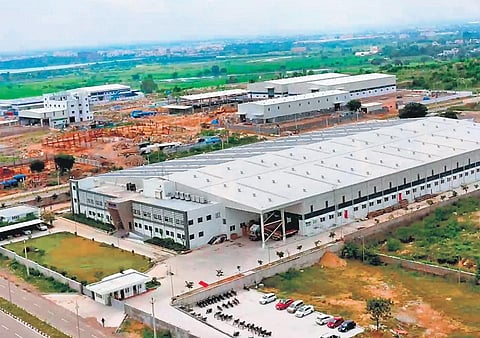

The government on Wednesday approved an allocation of Rs 33,660-crore under Bharat Audyogik Vikas Yojna (BHAVYA), aimed at developing 100 plug-and-play industrial parks to boost domestic manufacturing and attract investments.
Under the scheme, industrial parks ranging from 100 to 1,000 acres will be developed across the country, with a minimum area of 25 acres in North East and hilly areas over a six-year period from FY27 to FY32. In the first phase, 50 parks will be taken up. However, the land needs to be allotted by the respective state governments. “The state government will be the primary sponsor for taking up parks for development under the scheme. But the private sector can also come in for development of parks. However, they have to come through the state government,” said Amardeep Singh Bhatia, Secretary, Department for Promotion of Industry and Internal Trade (DPIIT).
The Centre will provide financial assistance of up to Rs 1 crore per acre for developing core infrastructure such as internal roads, along with several value-added facilities. Once the land allotment is done by the state government, the corresponding funds will be allocated by the National Industrial Corridor Development Corporation (NICDC). In some cases, additional funding requirements can be met through debt, stated the DPIIT secretary.
While the central government expects nearly 90% of the funds to come from states, it can also opt to allocate more funds if needed.
For projects involving private participation, there will be a tripartite model involving three stakeholders — the state government, the Centre through NICDC, and private developers. The exact contribution from each party will depend on the agreed project structure.
There will be a single window clearance mechanism to ensure hassle-free setting up of manufacturing units. The government aims to ensure that even smaller businesses get access to affordable manufacturing units.
“Big businesses usually develop their own infra, but smaller firms who want readily available infra will be beneficial,” added Bhatia.
In addition, the cabinet has approved the use of up to 25% of the total project cost for external infrastructure, subject to certain conditions, marking a significant expansion in the scope of support under the programme.
