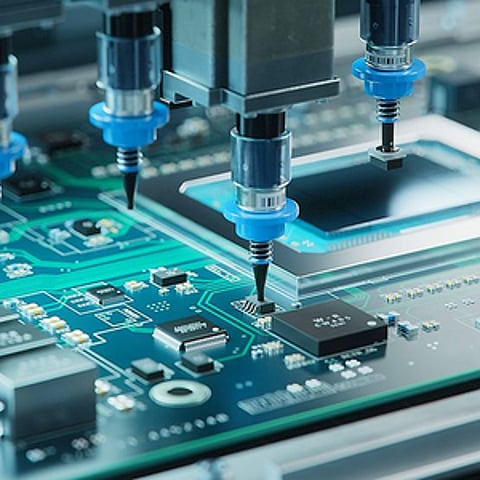

Following Iran’s attack on Qatar’s Ras Laffan LNG hub on March 19, which caused extensive damage, India’s semiconductor and printed circuit board (PCB) industry is bracing for potential disruption in helium supplies—a critical byproduct of liquefied natural gas. The development comes at a time when India is aggressively positioning itself as a global manufacturing hub for semiconductors and electronics, with companies investing heavily in supply chain integration.
Helium is a critical and largely non-substitutable input in semiconductor manufacturing processes.
Eswara Rao Nandam, managing director and CEO of Polymatech Electronics Limited, said the situation has not yet escalated into a full-blown shortage but is evolving into a strategic supply concern.
“The situation is not yet a full-scale shortage, but it is clearly evolving into a strategic supply concern. While Indian semiconductor and PCB players are not facing immediate production stoppages, the industry is transitioning into a precautionary and risk-managed mode,” he said.
Bengaluru-based Aimtron Electronics Ltd, which operates in PCB assembly and the broader electronics system design and manufacturing (ESDM) space, said short-term disruptions could affect semiconductor fabrication, testing environments, and other high-precision processes, with ripple effects across the ecosystem.
Mukesh Vasani, chairman and managing director of Aimtron Electronics, noted that early signs of price volatility and supply tightening are already being closely tracked by global chipmakers.
Nandam added that helium prices have surged sharply, in some cases rising 50–100% in the spot market within a short span, with supply tightening leading to allocation-based distribution in certain regions.
Ashok Chandak, president of the India Electronics and Semiconductor Association, said the crisis in Qatar has triggered a short-term price spike of 35–50%, with further upward pressure likely if disruptions persist.
However, he pointed out that helium is not widely used in India’s PCB assembly segment due to its high cost compared to nitrogen. “Companies may not see an immediate impact on production, but project timelines and equipment commissioning are beginning to face indirect pressures,” Nandam added.
The industry is also witnessing a slowdown in fresh orders for raw materials, although the immediate impact remains largely price-driven rather than supply-led.
In parallel, a shortage of specialised ceramic materials is adding to the strain on India’s electronics sector. The closure of over 550 ceramic units in Morbi—responsible for nearly 80% of domestic ceramic supply—due to fuel shortages has disrupted availability.
Multilayer ceramic capacitors (MLCCs), a key component used in smartphones, laptops, and automotive electronics, are particularly affected. While experts say it is too early to fully assess the impact, the shutdown is expected to create pricing pressures and potential supply bottlenecks across the electronics value chain.
“We are seeing initial price increases of around 5% on existing inventory, with expectations of a further 10–20% rise if the situation persists,” Nandam said.
