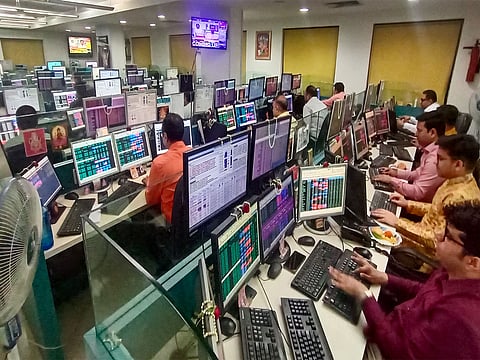

In what may appear as initial signs of deepening economic distress, India's equity markets plunged again on Tuesday with the rupee slumping to new low. While the sharp correction over the past four sessions stems from surging crude oil prices amid stalled US-Iran peace talks, relentless rupee weakness, and heavy FII outflows, investors have also become wary that escalating geopolitical tensions could derail India's growth trajectory.
Moody's Ratings on Tuesday slashed India's GDP growth forecast for the year 2026 by 0.8 percentage points to 6% on subdued private consumption, capital formation, and industrial activity amid higher energy costs. Add to it, Prime Minister Narendra Modi's call for austerity over the weekend in view of the US-Iran war has also triggered selling with investors interpreting the remarks as a signal of an imminent crisis.
Further, Chief Economic Advisor (CEA) V Anantha Nageswaran on Tuesday warned India must prepare for a prolonged phase of geopolitical fragmentation, technology bifurcation and elevated energy risks. Flagging the economic fallout of the ongoing West Asia conflict, the CEA, while speaking at the CII Annual Business Summit, said the crisis had become a live balance-of-payments stress test for India, with direct implications for inflation, the current account deficit and the rupee. Analysts expects the current account deficit to cross 2% this financial year against 0.8% in FY26.
The growing speculation over an imminent increase in prices of petrol and diesel is also keeping the market and consumers on the tenterhook. Petroleum Minister Hardeep Singh Puri on Tuesday raised concerns over the piling losses of oil marketing companies, saying that at some point the government will have to take a view on the matter.
The Sensex on Tuesday declined 1,456.04 points or 1.92% to settle at 74,559.24, while the Nifty fell 436.30 points or 1.83% to close at 23,379.55. The fresh fall comes after the two indices crashed 1.5-1.7% each on Monday. In the fast 4 sessions, the Sensex had crashed by 3,400 points and in two days, investors have lost Rs 17.3 lakh crore as the market capitalisation of all BSE-listed firms came down to Rs 455.80 lakh crore from Rs 473.10 lakh crore.
The broader market also witnessed a sharp correction on Tuesday, indicating widespread risk aversion beyond frontline indices. The Nifty Midcap100 index declined 2.54%, while the Nifty Smallcap index tumbled 3.17%. Selling pressure remained broad-based across sectors with Nifty Realty emerging as the top loser, followed by IT and Consumer Durables. These indices fell between 2% and 5%.
The uncertainty surrounding the conflict has kept crude oil prices elevated ($107.4 per barrel), leading to persistent Foreign Institutional Investor (FII) outflows. FII net sales stood at a whopping Rs 8,438 crore on May 11 and around Rs 2,000 crore on May 12. Reflecting these concerns, the Indian rupee weakened to a fresh record low of 95.62 against the US dollar amid fears of a widening import bill and rising inflationary pressures.
Jateen Trivedi, VP Research Analyst - Commodity and Currency, LKP Securities said that markets have turned increasingly cautious after PM Modi’s repeated remarks in recent days highlighting the economic strain from elevated imports, especially crude oil, edible oil, and gold. The comments have reinforced fears that sustained high crude prices could significantly impact India’s external balance and reserve positions, he added.
Siddhartha Khemka - Head of Research, Wealth Management, Motilal Oswal Financial Services, said that escalating tensions in West Asia have heightened fears of a prolonged geopolitical conflict, keeping investors risk-averse and triggering sustained selling across financial markets.
