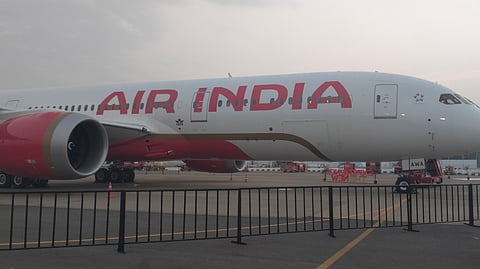

Singapore Airlines (SIA) said on Thursday that its net profit for the financial year 2025-2026 declined due to the absence of a prior year one-off accounting gain, coupled with the share of full-year losses from Air India.
Singapore Airlines' annual financial statement revealed that Air India's losses stood at about 2.8 billion dollars last financial year (FY26), its biggest annual loss since the airline was taken over by the Tata Group in 2022.
SIA, which owns a 25.1 per cent stake in Air India, stated that it remains committed to its investment in Air India.
“The Group’s (SIA) net profit declined by 1,594 million dollars (-57.4 per cent) to 1,184 million dollars, primarily due to the absence of the 1,098 million dollars non-cash accounting gain recognised in November 2024 upon the completion of the Air India-Vistara merger. The swing from a share of profits of associated companies last year to a loss this year (-846 million dollars) was due to the Group accounting for its share of Air India’s full-year losses, versus only four months the previous year,” said SIA in a statement.
Hit by rising jet fuel prices and airspace closures over certain regions, the Tata Group-run Air India has started taking measures to curb costs.
On Wednesday, Air India announced temporarily suspending half a dozen unprofitable international flights and reducing frequency across North America, Europe and Asian destinations.
SIA said that it is committed to its 25.1 per cent investment in the Air India Group, which is a core component of its long-term multi-hub strategy.
The airline said that it is working closely with its partner Tata Sons to support Air India’s multi-year transformation programme.
“This strategic investment provides the Group with a direct stake in one of the world’s largest and fastest-growing aviation markets, complementing its Singapore hub and strengthening its long-term growth,” said SIA.
It added that Air India faces headwinds such as industry-wide supply chain constraints, airspace restrictions, constraints on operations to its key Middle East markets, and elevated jet fuel prices.
“Nonetheless, it continues to make progress in its fleet renewal and aircraft retrofit program, initiatives to elevate the end-to-end customer experience, and improve its operational performance,” said SIA.
Despite a decline in profit, Singapore Airlines reported a strong operational performance. Operating profit rose 39 per cent to 2.375 billion dollars, driven by robust demand for air travel, higher passenger yields, and lower net fuel costs. Revenue climbed 5 per cent to a record 20.522 billion dollars as the group (SIA and Scoot) carried a record 42.4 million passengers during the financial year.
SIA said that heightened geopolitical tensions, including the conflict in the Middle East, are a major headwind for the airline industry.
The most immediate impact is on jet fuel prices, which have more than doubled since the conflict began, adding significant cost pressure for airlines.
As the Group’s fuel bills are typically priced on a lagged basis, the impact is only partially reflected in March 2026. The full impact is expected to feed through in FY2026/27.
