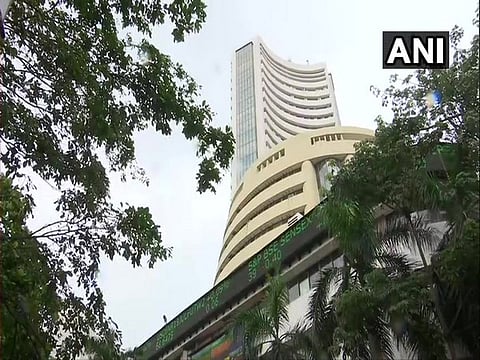

Unfazed by robust Q1FY27 GDP growth figures, India’s equity market continues to reel under selling pressure with benchmark NSE Nifty50 declining for the fourth consecutive session on Thursday. The BSE Sensex, meanwhile fell more than 400 points in the final five minutes of trading, between 3:25 pm and 3:30 pm, on Thursday.
The volatility was intense a few minutes earlier as Sensex fell from around 76,510.32 at 3:17 pm to 74,373.29 by 3:20 pm, a plunge of over 2,100 points in three minutes. The sharp swing in the 30-share index came on the first weekly derivatives expiry of September since the closing auction session (CAS) mechanism was introduced. It led to a steep surge in put option prices before the benchmark index settled at a much smaller loss.
At close, the Nifty50 declined 0.17% to settle at 23,873, while the Sensex fell 0.55% to close at 76,152.
While the newly introduced CAS continues to affect the closing price of the benchmark indices, fundamentals guiding the equity market also remain weak despite robust macroeconomic numbers.
“There may be no immediate Q1 GDP cheer for the market because, while India’s robust 7.8% Q1 FY27 GDP growth reinforces the strength of the domestic economy, near-term market sentiment is being driven more by global macro and risk factors,” said Sunny Agrawal, Head- Fundamental Research at SBI Securities. He added that over the past week, markets have remained under selling pressure amid rising bond yields in the U.S. and Japan, higher crude oil prices following escalating US-Iran tensions, and a stronger Dollar Index, raising concerns around global liquidity, inflation, interest-rate expectations and foreign investor flows.
In the past one month, the Nifty50 index has declined about 4% while the year-to-date decline is around 9%. India has emerged as one of the worst-performing major equity markets globally in 2026.
Shweta Rajani, Associate Director at Anand Rathi Wealth said that the strong GDP has not translated into a strong market rally due to multiple negative global factors rather than domestic fundamentals. India recorded real GDP growth of 7.8% in the first quarter of financial year 2027 (Q1FY27), significantly ahead of market expectations of 6.8 to 7.2% and up from 6.9% in Q1 FY26.
According to Ranjani, one of the major negative global factors is Fed Chair Kevin Warsh’s hawkish comments at Jackson Hole which triggered a sharp reassessment of US rate expectations and market pricing for a September Fed hike moved from roughly 40% to 60%, while the US 2-year Treasury yield jumped to 4.35%. Higher US yields typically make dollar assets more attractive and can put pressure on emerging-market flows, including FPIs into India.
“At the same time, rising US-Iran tensions have pushed Brent crude above $95 a barrel. For an oil-importing economy like India, sustained crude at these levels can increase inflationary pressures, widen the import bill, put pressure on the rupee and squeeze margins in crude-sensitive sectors. So, the current market weakness is less about India's growth outlook and more about the convergence of higher US yields, a stronger dollar, elevated crude prices and geopolitical uncertainty,” said Ranjani.
Going ahead, experts expect global events to guide market movement. Agrawal said that the current market stress should be viewed more as a reflection of global uncertainty and risk aversion rather than any deterioration in India’s underlying growth story.
Ranjani stated that in the near term, markets might be impacted by a series of events such as US jobs data on September 4 which will be important as it could influence expectations on the Fed's next move, while the September 16 FOMC meeting will be the bigger trigger.
