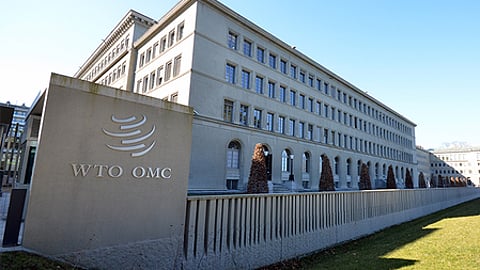

GENEVA: The global trading system is enduring its most sustained disruption in living memory amid challenges to trading rules that could batter living standards in a "geo-fragmented world", the WTO warned Tuesday.
The system is now in a decisive phase, the World Trade Organization said in its annual report, which "provides new evidence that a reversion to unilateral trade policy would impose large costs".
Such a reversal could slash global GDP by around five percent and drag down exports 18.6 percent by 2050, it warned.
"Global trade policy and the WTO are experiencing the most serious and sustained disruptions since the multilateral trading system was created 80 years ago," the report said.
It echoed a warning by its director general Ngozi Okonjo-Iweala in March, shortly after the start of the US-led war on Iran.
"We have seen trade rules challenged on a scale unseen since multilateral institutions were created to underpin open, stable and predictable global trade in the wake of the Great Depression and the Second World War," Okonjo-Iweala wrote in a preface to the report.
She said trade cooperation had "helped narrow income gaps between developing and advanced economies, and contributed to peace among members".
Although "the global trading landscape has changed significantly... the founding logic of the system, that all economies are better off cooperating rather than acting unilaterally, remains as relevant today as ever", she added.
'Safeguard what works'
But the outlook has darkened after US President Donald Trump launched a tariff blitz since returning to the White House in January 2025, and amid soaring geopolitical tensions, particularly in the Middle East.
The WTO pointed to a range of factors that have hit cooperation, including shifts in economic power and the growing prominence and diversity of government intervention in markets.
Looking forward, WTO economists analysed the likely economic growth development under different scenarios.
They found that "fragmentation along geopolitical lines could reduce global GDP by about five percent", Okonjo-Iweala told diplomats Tuesday.
And "in a world where the WTO disappears and is replaced by a network of FTAs [free trade agreements], the losses would be closer to seven percent", she warned.
Moreover, the costs of any erosion of multilateral trade would not be born equally, as the smallest and poorest economies would be particularly vulnerable.
"In contrast, if members act purposefully to reinforce multilateral trade cooperation, safeguard what works, reform what doesn't, it could boost global GDP by roughly three percent," Okonjo-Iweala said.
Growing restrictions
The WTO, which will unveil an update to its global trade forecasts on October 8, remains the linchpin of the rules-based global trading system, with a full 72 percent of global trade still operating under its rules.
"At the same time, two years ago, that share stood at 80 percent," the agency's chief economist, Robert Staiger, told AFP, acknowledging that "the trend is disturbing".
"Another sign that global trade is coming under pressure is that new tariffs and trade restrictions now cover 11 percent of global imports, and that represents the highest coverage in over 15 years," he said.
While global trade figures remain quite strong, Staiger suggested artificial intelligence was helping to shore up the system.
"We also need to acknowledge that some of the resilience may be reflecting AI and the AI boom and the fact that AI-enabling goods are extremely trade intensive," he said.
"There's a lot of imports that go into producing AI enabling goods like servers and factories and computers and data centres, and that investment boom... may be masking some of the drop in world trade that might otherwise be occurring."
Staiger warned though that "AI trade tends to be relatively narrow in terms of the nations and the members that are enjoying that trade".
"Putting one's eggs in the basket, [thinking] that everything is fine because world trade continues to grow at a nice clip, is a bit of a risky endeavour," he said.
