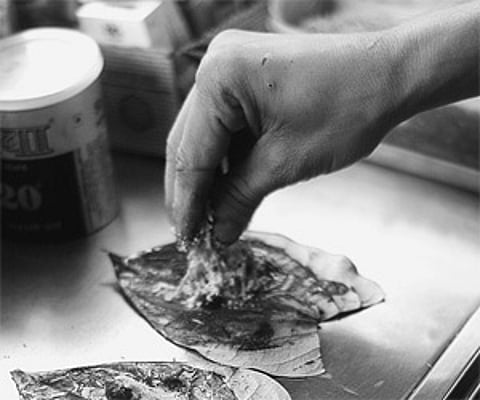

BANGALORE: The Vedas refer to the paan as being the first offering to the guru. More than two thousand years ago, the ancient book of Sri Lanka, ‘Mahawamsa’, mentioned the use of what P Guha of IIT-Kgp calls the ‘The Neglected Green Gold of India’.
The betel leaf -- a practice for thousands of years, a craze among aristocrats since ancient days, an integral part of Asian, and, of course, Indian history.
Vatsyayana alludes to the leaf in Kamasutra, “After cleaning the teeth and having looked into the mirror and having eaten a tambula (betel preparation as called in Sanskrit) to render fragrance to the mouth, should a person start his day’s work.” In fact, he included betel leaf in the ‘sola shringar’, one of the 16 toiletries.
Paan is ubiquitous in the country as are the men who deftly fold these leaves in multiple ways, stuffing them with exotic fillings.
Preparing the paan is an art and in India, the technique is usually passed down through generations.
Sushil Kumar Pande has grown up seeing his grandfather and father make paans, tweaking the simple preparations with their special touches. This young man, who hails from Varanasi (one of the most famed places for paan), says while manning the store on Millers Road in Little Empire, “I have been involved in the business full-fledgedly for the last two years. But I have been learning from them for the last 20 years.” He has chosen Bangalore as his workplace since others in his family have brought the Varanasi business to the city.
Calcutta Sweet, Calcutta Sada (read plain), 120, 420, and what Bangalore is famed for, the Maghai paan, which he keeps in an ice box and which melt in your mouth, are Sushil’s forte and he charges between Rs 5 to Rs 10 for them. Apart from the usual areca nut and slaked lime, he keeps at least 10 spices, which include gulkhand, coriander, aniseed, clove, cardamom, sweetener, coconut scrapings, beaten gold and silver, jelly, pepper mint, flavouring agent and fruit pulp.
Most paan sellers source betel leaves only from Varanasi and Kolkata, like the delicately flavoured paan from West Bengal, Desi Mahoba. Maghai and Jagannath are the main paans of form Varanasi. Ravi Shankar Singh says, “The prices of the leaves differ according to variety and season. Winter is good, but in summer the prices soar. The Maghai leaf is the most expensive, 100 leaves can cost anything between Rs 400 to Rs 700, depending on the season.” Ravi is a self-taught artist. “I used to see the paan sellers around and learnt on my own.” After a stint in Mumbai, he opened his shop at the corner of St Marks Road 10 years back. He opens the shop daily at 7.30 a.m.
and stays there till midnight, seven days a week, and is flooded with customers all the time. “I can make 10 paans in a minute,” he declares.
The paan daani, the spitoon, the nawabi andaaz are history.
But the paan culture has been kept alive in the little kiosks that dot any Indian city.