
BANGALORE: It’s time for a road trip, time for more art and architecture of the great Hoysalas, at this temple village of ‘Melkote’ set amidst hillocks known as ‘Yadavagiri’ or ‘Yadugiri’ that stand overlooking the Cauvery valley. At a distance of 133 kms from Bangalore, it is the perfect destination to head to, when all you have is a day’s break to venture out from the busy city life; a maximum of 6hrs up & down is all it takes, excluding the time you wish to spend there, naturally.
It’s a blissfully pleasant journey; for a city slave it’s like a redemption call, especially riding through the country side that has surprisingly smooth roads complimented with farming lands.
A tiny pond initiates the start of your uphill travel, on a road that takes a couple of wicked twists before it gets plainer and straighter as you pass by the guest house, travellers bungalow, petty shops and houses by the side.
The ‘Thirunarayana’ or ‘Cheluvanarayana Swami ‘Temple at the foothills is the main temple and the probable reason for Melkote also being known as ‘Thirunarayanapuram’; it is a simple but huge, square building incorporated in the Hoysalas style and stands today with its walls showing empty spaces where once beautiful sculptures adorned it. ‘Utsavamurthi’ also known as ‘Cheluvapille Raya’ or ‘Cheluvanarayana Swami’ is the metallic deity of the temple and according to legend, Ramanujacharya restored this metallic deity from the Muslim invaders who had stolen it away.
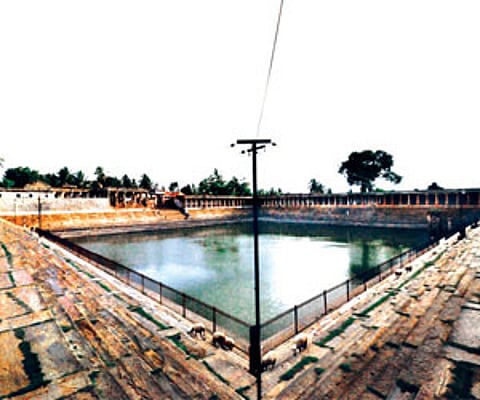
From the main temple a considerably exhausting and enchanting journey of a barefooted, up-hill climb through steep steps and occasional encounters with grazing buffalos and goats takes you to the ‘Yoga Narasimha’ temple atop the hill. A part of this temple infrastructure is the large pond called as ‘Kalyani’ or ‘Kalyani theertham’; it is surrounded by ‘mandapas’ and large steps leading to the water that is inexpressibly beautiful.
After the Hoysala rule, under the patronage of Mysore Wodeyars’ the temples were endowed with expensive ornaments; Raja Wodeyar presented a crown known as the ‘Raja-mudi’ as early as 1614, further Krishnaraja Wodeyar III presented a gold crown known as ‘Krishnaraja-mudi’ or ‘Vairamudi ‘or ‘Vajramukuta’, that take centre stage during the ‘Vairamudi Sevai’ festival held here, every year. Apart from these three historic sites, Melkote is also home to wildlife such as wolves, jungle cat, leopard, bonnet macaque, langoor and pangolin, to protect which the ‘Melkote Temple Wildlife Sanctuary’ was established in 1974.
With these renowned Vaishnava temples and a colossal ‘kalyani’, Melkote is a destination of religious importance, a place of study for art historians and architects, certainly a fascination for a photographer and it is also an ornithologist’s paradise, with numerous species of birds native to the area, more reasons why it should picture in your list of travel destinations.
bngexpresso@epmltd.com
