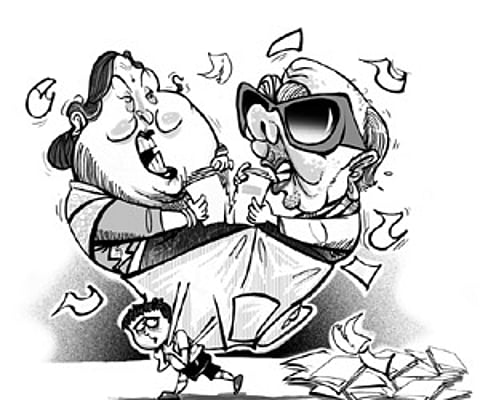

The Samacheer Kalvi scheme was introduced by the DMK government, which said it wanted to unify the syllabi of the four school boards in Tamil Nadu — State, Matriculation, Anglo-Indian and Oriental. This system was used in 2010 for Class 1 and Class 6 alone, and was supposed to be introduced for other classes up to 10 this year.
However, in May 2011, Chief Minister J Jayalalithaa said the new textbooks were not up to the mark, and the government decided to postpone implementing the Uniform School Education (USE) scheme. Some groups favour the USE being started for all classes this year, and the case is now being heard in the Supreme Court. Meanwhile, textbooks have not been issued to school students.
How It All Began
In November 2009, the Tamil Nadu Uniform System of School Education Ordinance was passed by the Governor to introduce the USE, based on the findings of a committee. The ordinance said the aim of the USE was to “ensure social justice and provide quality education” in schools.
The ruling DMK government said this could not be discussed in the Legislative Assembly at that time, as the Assembly was not in session, and the Governor had taken action because the matter was urgent.
The new system was introduced for Classes 1 and 6 in June 2010. Some reports said parents and schools felt the standard of the syllabus had gone down, and were worried students might not be able to compete in other examinations. Many schools told parents they would distribute extra material, in addition to the textbooks. The new curriculum was used through the year for the two classes.
The Controversy
On May 22 the new AIADMK Government under Jayalalithaa said it would put on hold the introduction of USE for the other classes. The State government said it was not against the USE, but would appoint a committee of experts to improve the quality of the syllabus. This meant the textbooks which had already been printed could not be used, and new books under the old system would have to be printed. So the reopening date of schools was postponed. Prince Gajendra Babu, general secretary of the State Platform for Common School System, filed a Public Interest Litigation (PIL) in the Madras High Court. He said deferring introduction of the USE after an Act had been passed by the previous government went against the Constitution. He said there was no proof that the textbooks were of poor quality, and the confusion over the syllabus would stress the school children.
The State government filed an appeal in the Supreme Court, which in turn ordered the State to appoint a panel of experts to study the curriculum. It handed the main petition back to the Madras High Court. Three days later Jayalalithaa asked a nine-member committee to review the USE syllabus. The members included the Chief Secretary, State Director of School Education, representatives of the National Council of Educational Research and Training (NCERT), as well as principals and founders of several schools.
The State government wanted the committee to make sure that the textbooks did not contain “political propaganda material” of the DMK. The concern arose because a poem by former Chief Minister M Karunanidhi was included in a textbook, and the curriculum was reported to include chapters on his life and that of his daughter, the 2G scam-accused Kanimozhi.
The committee submitted its report to the Madras High Court on July 5. The panel felt that the textbooks could not provide good education, and seemed to have been prepared in a hurry. It said the common syllabus was not age appropriate, and would overburden students. The experts said the schoolbooks could not be used this year, as the curriculum needed changes and there were grammatical errors in the books.
The Madras High Court’s Verdict
On July 18 the Madras High Court ruled that the State government had “exceeded its powers” by amending an Act that was in effect. The court said the USE must be implemented immediately and textbooks issued to students by July 22. The panel of experts had not rejected the system outright, the court felt, and suggested additional material could be distributed to students in the form of booklets over the next three months while objectionable material could be blacked out.
Both the State government’s allies and the opposition urged Jayalalithaa not to appeal against the verdict, but the State filed an appeal in the Supreme Court, saying the High Court had failed to appreciate that a detailed study was required to overhaul the syllabus before putting the USE into effect
What does the Supreme Court Say?
The Supreme Court refused to stay the order of the Madras High Court, but extended the deadline for distribution of books to August 2.
Since July 26 the case has been heard regularly in the apex court. On the first day the State government said it would be hard to introduce the USE this year as the content of the school books had to be revised.
The judges hearing the case said the amendment was vague, and asked for a specific time by which the government would be ready to implement the system. The State answered that a high-level committee had to be set up to review the current syllabus and make sure the students would be on par with their counterparts in other states so it could only be introduced next year.
The next day the judge asked why the State had made an amendment in the Act when the Madras High Court had already given it a year’s time to implement the USE. Lawyers representing parties that wanted to postpone the USE said the State legislature had the right to make an amendment. On August 9, a day after Jayalalithaa said her government would abide the Supreme Court’s verdict, the court ruled in favour of the USE and directed the State to implement it within 10 days.
