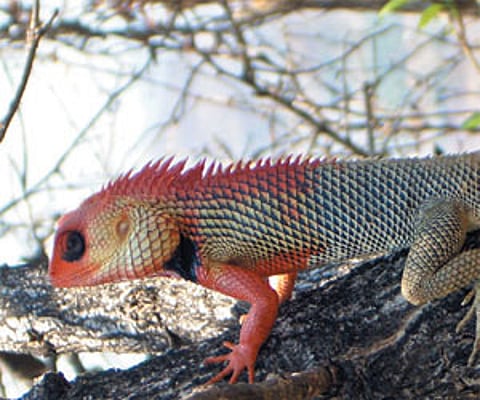

I was sitting at a desk in my house when I heard a scuffle in the garden. Going out to the balcony, I looked down into our garden to see Tiger, our pet cat (we think she’s our pet; Tiger thinks we are her pets). Tiger was playing with something in the garden. I looked closely and realised that she was harassing a lizard. I rushed downstairs and quickly separated Tiger and the reptile. Tiger had found a Garden Lizard Calotes versicolor and was playing with it. Shooing her away, I picked up the lizard and put it up in a bush, where it scurried away to safety.
The Garden Lizard is commonly seen throughout India in gardens. It is found on the ground or in trees, bushes and shrubs. The Garden Lizard belongs to a family called Agamids. Most agamids have a series of spines on the body. Males of the Garden Lizard have a large swollen head while females and juveniles lack this. During the breeding season, the upper half of the male lizard turns a bright red; the male adopts the latest fashion in clothing in order to attract the female. While this makes the lizard prominent and attracts the “ladies”, it also makes it more noticeable for predators. Hence the lizard adopts an interesting strategy; it changes its colour, if approached or threatened. The red on the head and body magically changes into a duller colour in a few minutes!
During breeding season, the male lizards are aggressive and will fight other males to protect their territory.
On occasion, the lizard will flex its muscles by moving its head and body up and down as though it is doing push ups, in the hope of intimidating another male! The lizard’s red colour has resulted in it being called the Bloodsucker. People mistakenly believe that the lizard bites and sucks people’s blood! Nothing could be further from the truth — the lizard is harmless and does not even bite. In fact, just like so many other creatures in nature, by feeding on insects, some of which may be pests, the lizard plays a crucial role in nature’s web of life.
Lizards, being reptiles, are “cold-blooded” animals, unlike birds and mammals which are “warm-blooded”. Hence reptiles need the sun to regulate their body temperatures. During the cold winter season, reptiles hibernate (winter sleep). So while most reptiles are active during the summer and monsoon months, they disappear in the winter. In southern India, where the winters are milder, the reptiles are active throughout the year. Watch out for the Garden Lizard in your area — and remember, it will not suck your blood!